
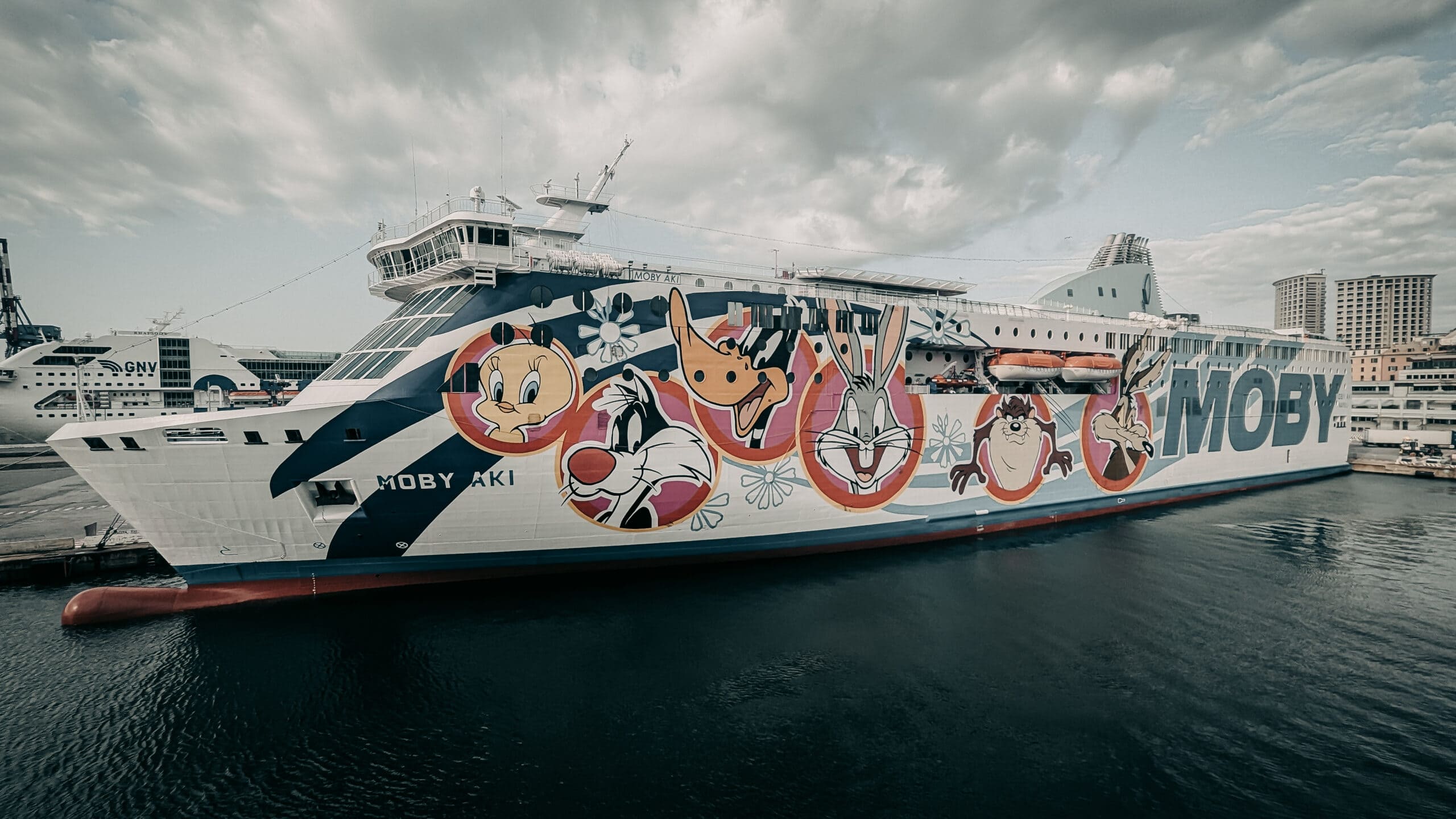
Some days on a trip are about discovery. This one was about closing the loop. Day 29 was the final day of ROADTRIP 2025 — an overnight ferry from Ajaccio, a long transit across northern Italy, and then, fittingly, one last mountain pass before rolling back into my own driveway in Pratteln.
A Restless Night at Sea
The crossing from Ajaccio to Genoa was calm this time, at least compared to some of the other ferry legs of this trip. The sea was quiet, the ship barely rolled, and I could actually get some sleep — though “sleep” is a generous word for it. I hadn’t brought the motorcycle’s air mattress along for this leg, thinking a short overnight crossing wouldn’t need it. That turned out to be a small miscalculation: my bed for the night was a seat in the restaurant area, surrounded by other travelers doing the exact same thing, everyone slouched at odd angles, jackets rolled up as pillows. Comfortable it was not, but I managed to doze on and off until morning, waking every hour or so to shift position and check how much distance was left.
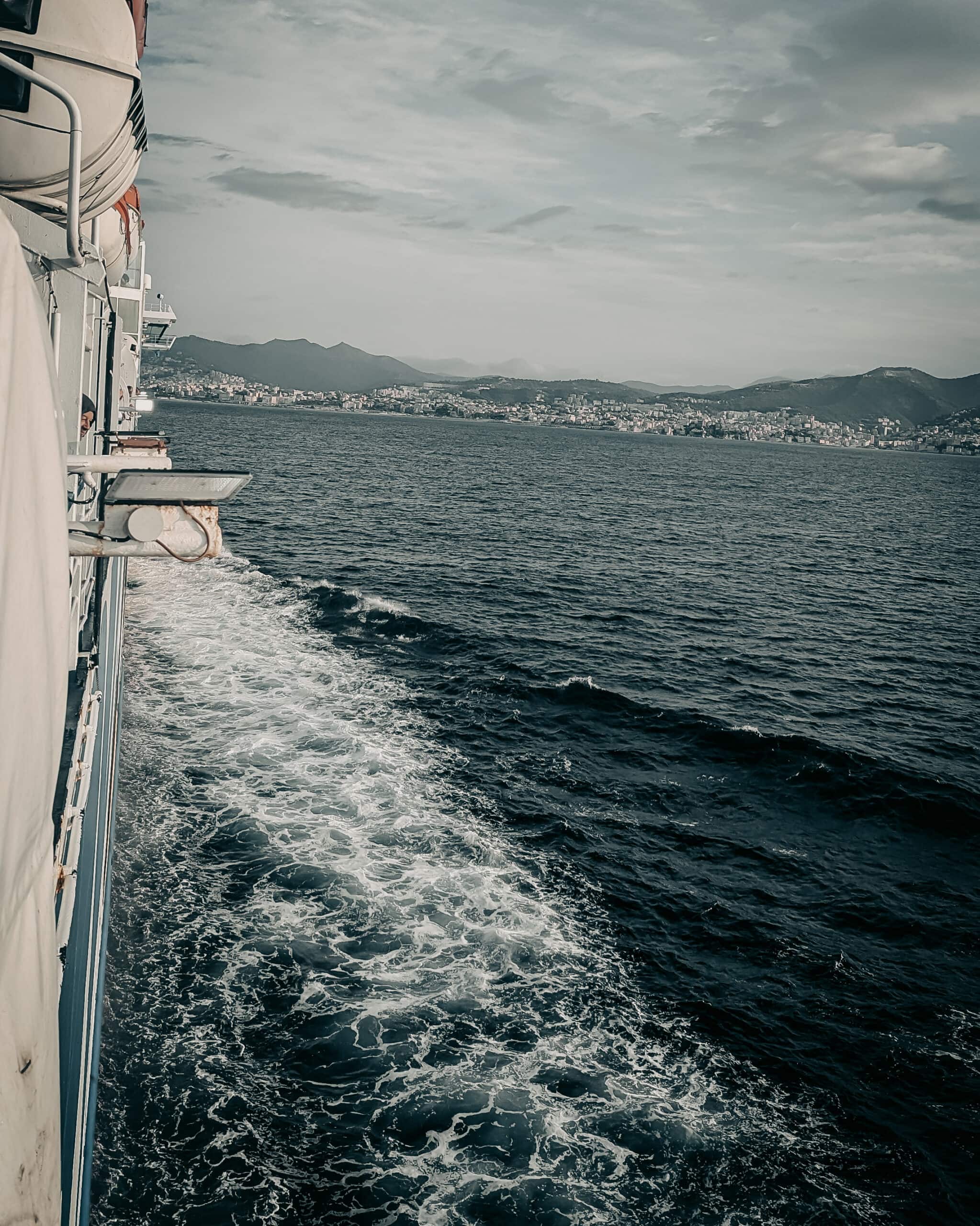
The reward came at sunrise. Good coffee from the onboard café, a clear sky slowly opening up over the water, and the kind of golden light on deck that makes you forget how stiff your back feels. I spent a long time up there just watching the Italian coast slowly resolve out of the haze as the ship approached Genoa — hills first, then the sprawl of the city climbing up the slopes behind the harbor, then the port itself, already busy with other ferries and cruise ships coming and going, cranes working the container terminals in the distance. After weeks of island roads and Mediterranean light, this felt like a genuine return to the mainland — and, in a way, the unofficial start of the ride home.
Genoa, and the Long Road Toward Switzerland
Rolling off the ferry in Genoa, I had a decision to make. Part of me considered detouring into the mountains for one more scenic stretch of road before heading home — there’s no shortage of good riding in Liguria and Piedmont, and the hills behind Genoa are full of tempting little passes I’ve never ridden. But after 29 days on the road, I was honestly just happy at the thought of getting home. There comes a point on any long trip where the pull of your own bed, your own kitchen, and familiar faces starts to outweigh the appeal of one more detour, however scenic. This was that point.
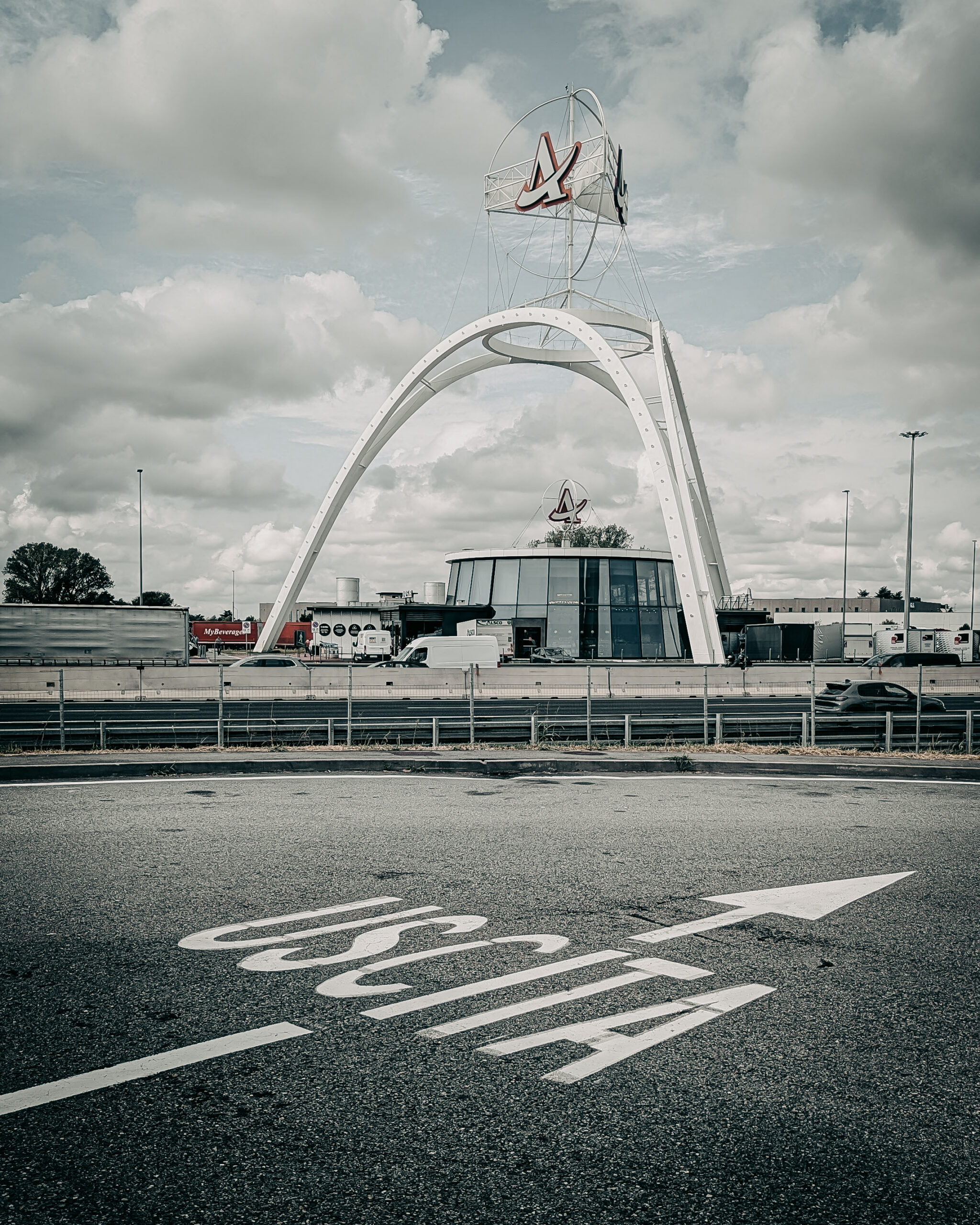
So instead of chasing one last hidden gem, I pointed the bike north and took the direct route: from Genoa toward Milan, past Milan, and on to the Swiss border. This entire stretch was pure Autostrada — toll highway all the way, the kind of riding where you switch your brain into cruise mode, set a steady pace, and just log the kilometers. Not glamorous, but efficient, and honestly a fitting contrast to the winding coastal roads of the previous four weeks. Traffic was heavy in places around Milan, trucks lined up at the tollbooths, the usual mix of Italian driving styles weaving between lanes — but it moved. I stopped once at one of the big Autogrill service stations along the way, one of those distinctive bridge-style rest stops straddling the highway, for fuel and a quick coffee before pushing on. I crossed into Switzerland and stayed on the highway for the first stretch on the Swiss side too, watching the scenery shift from flat Lombardy farmland to the first proper foothills of the Alps, the air noticeably cooler and cleaner almost the moment I crossed the border, before deciding it was time to change plans.
Three Ways Over the Gotthard
Because instead of continuing north through the flat, fast highway tunnel, I decided to ride over the Gotthard Pass — properly, on two wheels, in the open air.
What a lot of people don’t realize is that there isn’t just one way over the Gotthard. There are actually three. First, there’s the Autobahn tunnel — fast, practical, and about as exciting for a motorcyclist as a parking garage, though it does save you a good hour or more if you’re just trying to get through. Second, there’s the modern pass road, well paved and smooth, the one that gets recommended to cars and to riders who want the views without the drama, climbing up to the summit at just over 2,100 meters with wide, sweeping curves. And then there’s the third option: the old, original pass road — largely paved in cobblestone, historic, narrow, and much less used than the other two, tracing more or less the same line that traders and travelers have used to cross the Alps here since the early medieval period. That was the one I wanted, and after 29 days of a trip built around finding the more interesting road rather than the faster one, it felt like the only honest choice for the last mountain crossing of the whole journey.
Rain at the Foot of the Pass
Of course, right as I reached the base of the Gotthard, it started to rain. Typical mountain timing — clear skies the entire way from Genoa, and then, exactly at the one spot where I actually wanted good conditions, the clouds decided to open up. I pulled over at a small parking area, dug the rain gear out of the panniers, and got changed right there on the roadside while trucks and cars rolled past toward the tunnel entrance.
Standing there in the rain, I had a moment of genuine hesitation. Cobblestone gets noticeably more slippery when it’s wet — the individual stones are rounded and polished smooth by more than a century of traffic, and water sitting in the gaps between them does nothing to help traction. A wrong moment of throttle or a poorly timed lean could easily end badly on a surface like that, especially loaded down with luggage after 29 days of gear accumulating on the back of the bike. For a minute I genuinely considered just taking the easy way out and heading for the tunnel instead — no one would have blamed me, and after nearly a month on the road, nobody would have thought less of a rider choosing the safe, dry option on the very last big pass of the trip.
But I decided to go for it anyway. This was the last big mountain moment of the entire trip, and I wasn’t going to let a bit of rain talk me out of it.
The Tremola: Riding History in Cobblestone
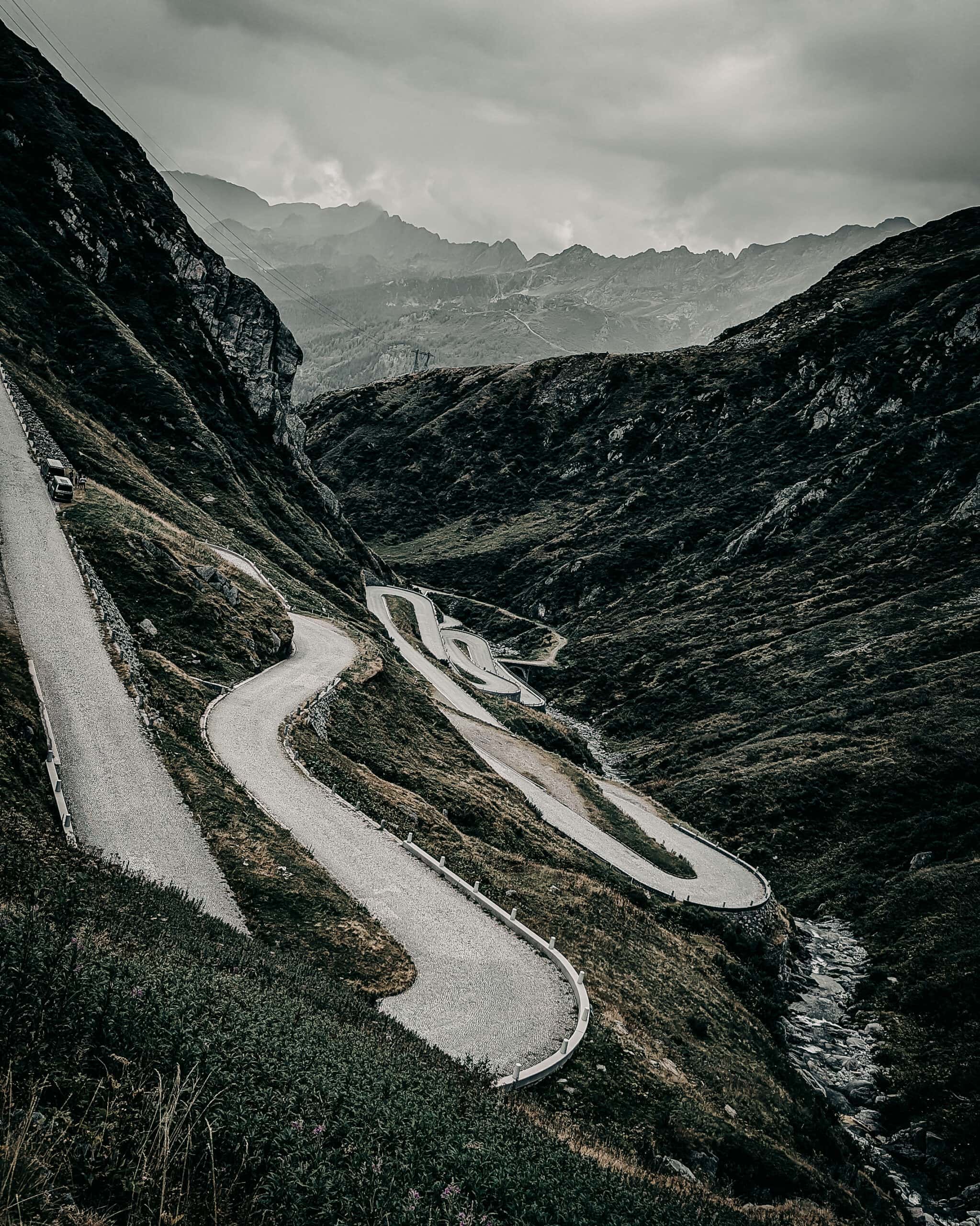
The old road up the Gotthard — known locally as the Tremola, Italian for “the trembling” — is unlike almost anything else in the Alps. Dozens of tight switchbacks are stacked into the mountainside on the southern approach, all laid with hand-set cobblestones that have been there for well over a century, a protected historic monument as much as a functioning road. It’s slow going by design; you’re not supposed to rush it, and the surface makes sure you don’t. Every stone shifts the bike just slightly under you, a constant low-frequency vibration through the bars that reminds you exactly what kind of road you’re on.
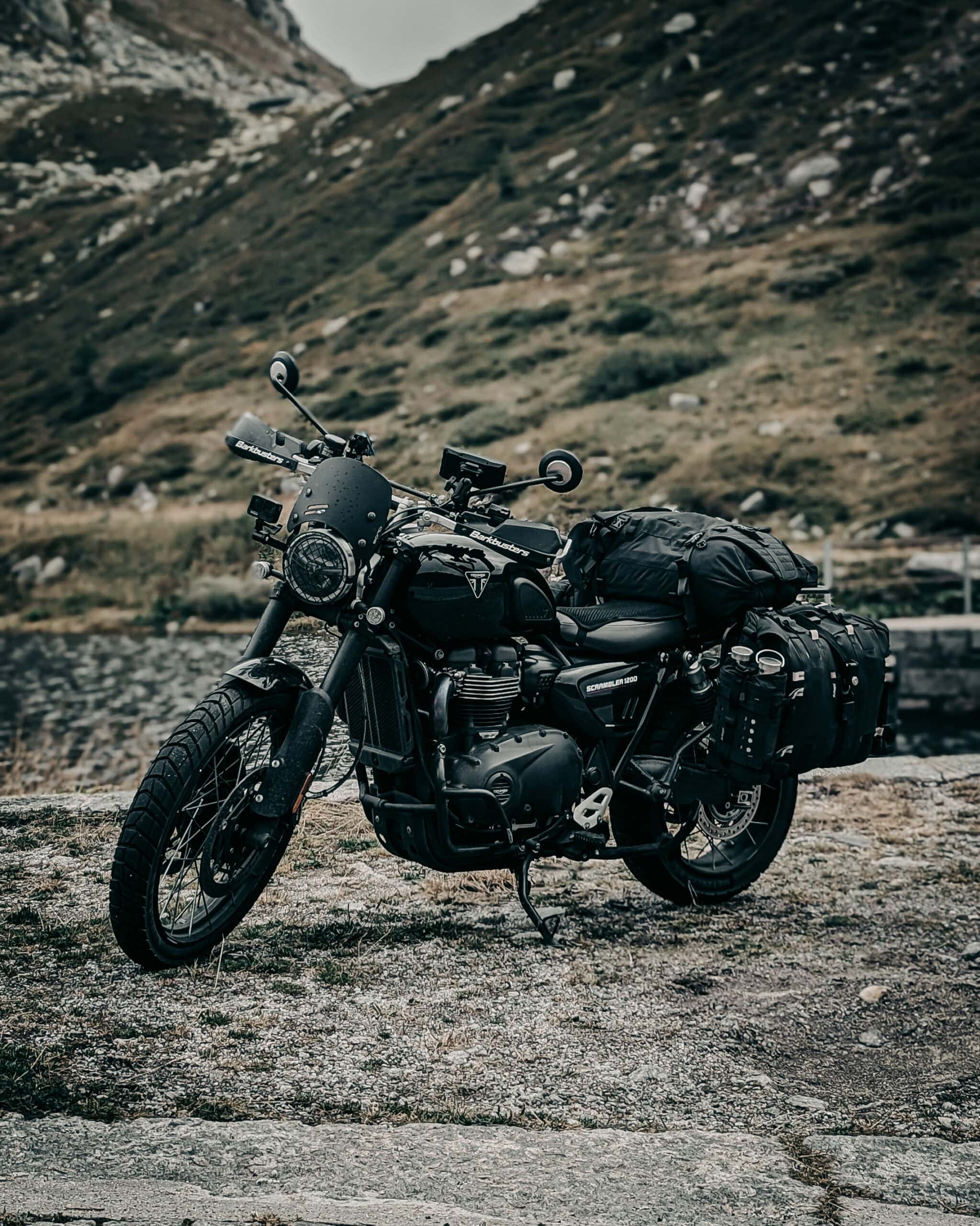
And I was rewarded for the decision. The rain eased off not long after I started climbing, and I got the chance to stop and take some genuinely beautiful photos along the way — switchback after switchback curling down into the valley below me, drystone retaining walls holding the road in place, and that particular grey-green color the Alps get right after rain, when every blade of grass and every rock face seems to be lit from within. Riding it loaded with luggage, standing on the pegs through some of the tighter hairpins, felt like a proper send-off for a bike that had carried me across two continents.
Clouds at the Summit
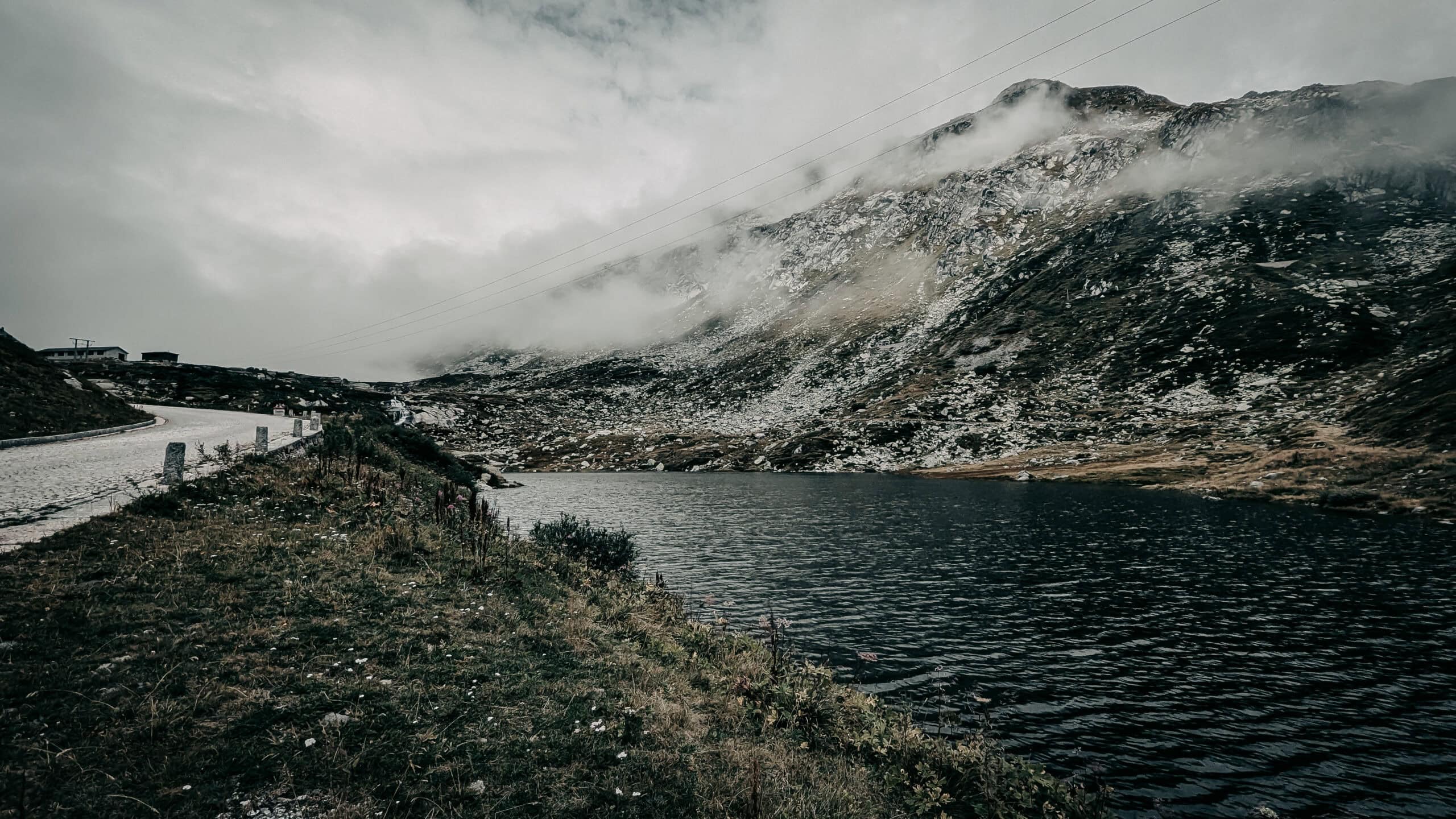
As I got higher, the cloud cover began to drop, and by the time I reached the top of the pass, low-hanging clouds were rolling right across the summit — draping over the rocky slopes, catching on the ridgelines, occasionally opening up just enough to reveal a small mountain lake or a stretch of road before closing in again seconds later. The temperature dropped noticeably, the wind picked up, and everything took on that muted, almost monochrome look you only get above the treeline in weather like this. It was genuinely atmospheric, exactly the kind of moment you hope for on a mountain pass and rarely actually get — usually you’re either rained out completely or riding under a flat, boring sky.
I stopped for a while near the small lake at the top, just taking it in. Riding the Gotthard again, in Switzerland, on the old cobblestone road, with clouds settling over the summit — it was one of those moments that reminded me why this whole trip existed in the first place. Not the biggest mountain, not the most exotic country of the trip, but somehow it felt like exactly the right note to end on. I really enjoyed it, probably more than any other single stretch of road in the last few days combined.
Down to Andermatt, and the Final Stretch Home
From the top, I began the descent on the other side, dropping down out of the clouds into Andermatt, the little alpine town that sits right at the crossroads of several major Swiss passes. The weather cleared almost completely on the way down, as if the mountain had decided I’d earned one last dry, sunny stretch before the trip was over. From Andermatt it was straight back onto the highway, heading toward Luzern and then Basel — the last purely functional stretch of the whole trip, putting kilometers behind me on familiar Swiss Autobahn. There’s something strange about riding roads you know by heart at the very end of a trip like this — the same tunnels, the same exits, the same view of Luzern’s lake from the highway that I’ve seen dozens of times before, except this time it meant I was almost home rather than just heading out for a weekend ride. Finally, I turned off toward Pratteln and rolled up to my own front door. Safe, tired, and full of an almost unbelievable amount of impressions from the past four weeks.
Home in Pratteln — The Numbers Behind 29 Days
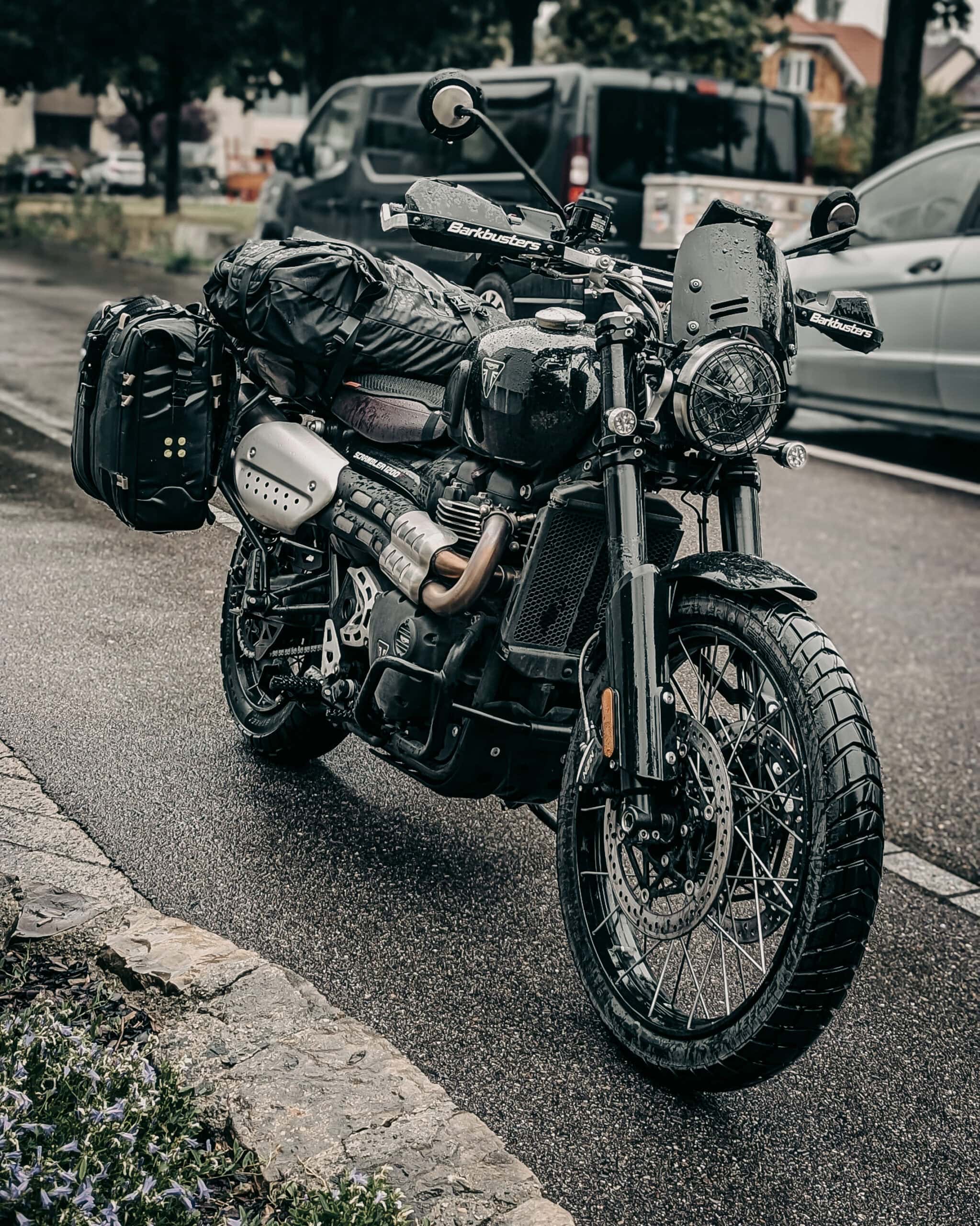
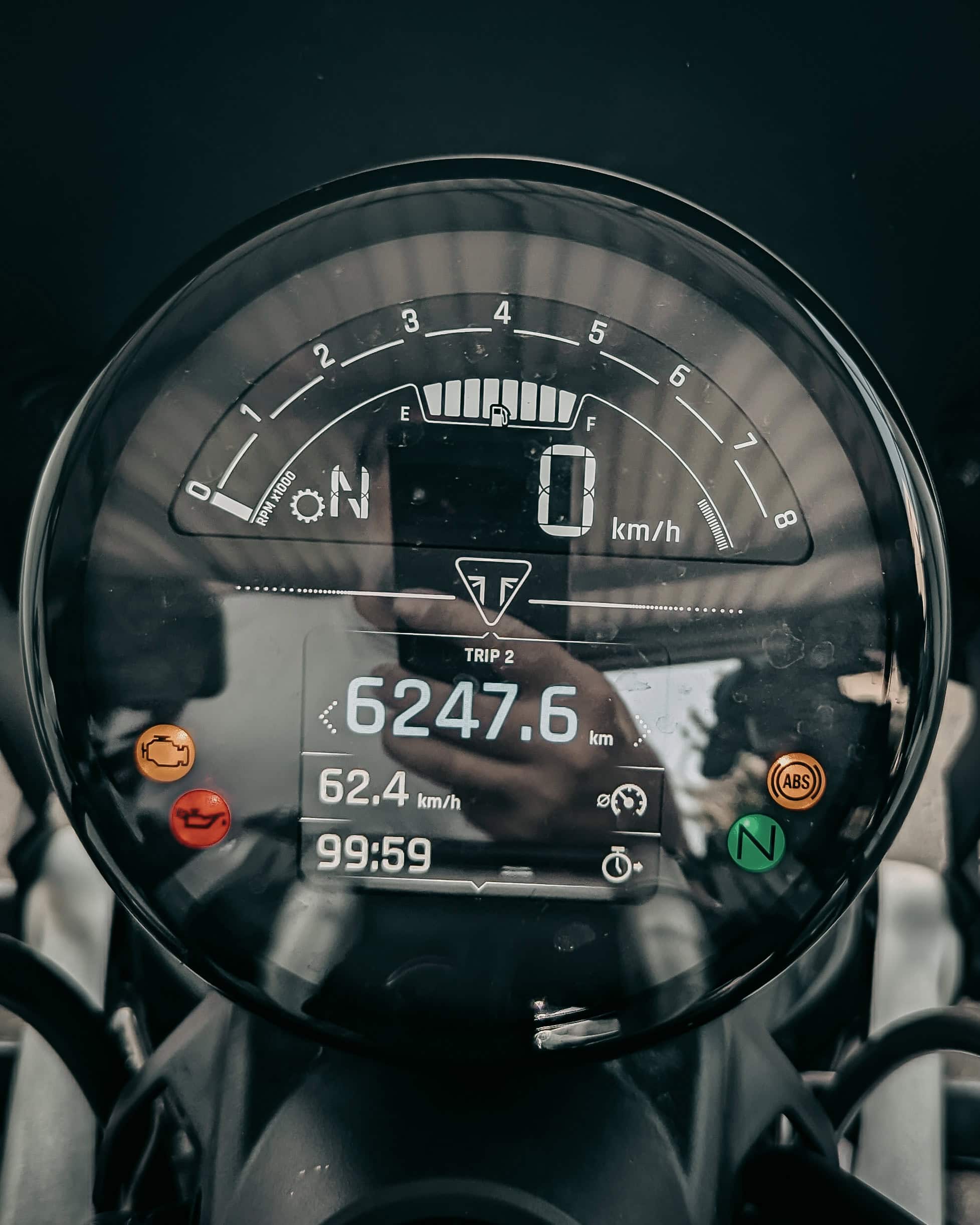
It’s a strange feeling, walking back into your own home after a trip like this. Everything is exactly where you left it, but you’re not quite the same person who left. Before I let the trip fade into memory, though, I wanted to put a few numbers on what this journey actually was:
- 29 days on the road
- 6,247 kilometers covered
- 99 hours and 59 minutes of actual riding time on the motorcycle
- 25 hours spent on ferries
- 10 countries visited
- 2 continents crossed
Ten countries in 29 days, spread across two continents, meant a genuinely wide mix of roads, languages, currencies, and landscapes — deserts and coastlines, mountain passes and island roads, ferries linking one leg to the next. Every one of those countries left its own mark on this trip, and honestly, on me.
Numbers like these never quite capture what a trip actually felt like — but they’re a good frame for it. Six thousand kilometers is a lot of tarmac, cobblestone, gravel, and ferry decks. Ten countries is a lot of border crossings, currency changes, and moments of “wait, how do I say thank you here again?” Nearly a hundred hours of actual saddle time is enough to memorize every rattle and creak the bike makes, and to know exactly how your body feels after six, eight, or ten hours of riding in a single day. And two continents is something I still have to remind myself actually happened, considering this journey included a crossing over to the Asian side of Istanbul and ended, 29 days later, with a Swiss mountain pass in the rain.
Looking back over the whole trip, it’s the contrasts that stand out the most. There were long, hot days of highway riding just to cover distance, and there were mornings where I barely made it fifty kilometers because I kept stopping for photos. There were nights sleeping rough with the bike’s air mattress in the middle of nowhere, and nights in small hotels where a hot shower felt like the height of luxury. There was a herd of cows blocking a mountain pass in Corsica, quiet evening markets by the Mediterranean, ferries connecting islands and continents, chain maintenance done at a small hotel, and now, to close it all out, cobblestones and low clouds on one of the most famous passes in the Alps.
None of it would have been possible without a bike that simply kept running, day after day, through heat, rain, cobblestones, gravel, and highway alike. Almost 100 hours in the saddle and over 6,000 kilometers without a single serious mechanical issue says a lot — a bit of routine chain oiling along the way was about as dramatic as it got. That’s not something I take for granted on a trip of this length, crossing this many kinds of terrain and climate.
It feels genuinely good to be home after this long stretch away — to sleep in my own bed, to not have to pack panniers in the morning, to just exist somewhere familiar for a while. At the same time, I know the impressions from this trip are going to stay with me for a long, long time. This is where ROADTRIP 2025 ends, but it certainly won’t be the last one.
Thanks for following along on this journey, day by day, for 29 days and thousands of kilometers. Photos from this final leg are on their way — and with them, a proper farewell to this trip.