
After the White Night festival in Alexandroupoli, I woke up to another scorching day ahead – but a calmer one, at least on paper. No border crossing today, no forced return to a workshop, no engine warnings lighting up the dash. Just a ride west along the Thracian coast toward Thessaloniki, the second big stop on my way home. What I didn’t expect was that this supposedly “easy” transfer day would hand me one of the most beautiful, unplanned sights of the entire trip – and, a few hours later, one of the more uncomfortable nights I’ve had since leaving Switzerland.
Leaving Alexandroupoli, Onto the Backroads of Thrace
I packed up the Scrambler, said goodbye to my overpriced little room with its postage-stamp window, and pointed the bike west. Instead of grinding out kilometers on the motorway, I decided to stay mostly on the country roads – Landstraße instead of highway. After days of tolls, border checkpoints, and dense traffic, I wanted a slower, quieter kind of riding for once.
The route took me through the flat, sunburnt landscape of Eastern Macedonia and Thrace, a part of Greece most tourists never see because it sits well off the usual island-hopping trail. Wide fields stretched out on both sides of the road, dried to a pale gold by weeks of summer heat, dotted with scattered villages and the occasional small roadside chapel standing alone in the middle of nowhere. There were long stretches where I didn’t pass another vehicle for minutes at a time, just the sound of the engine and wind against my helmet.
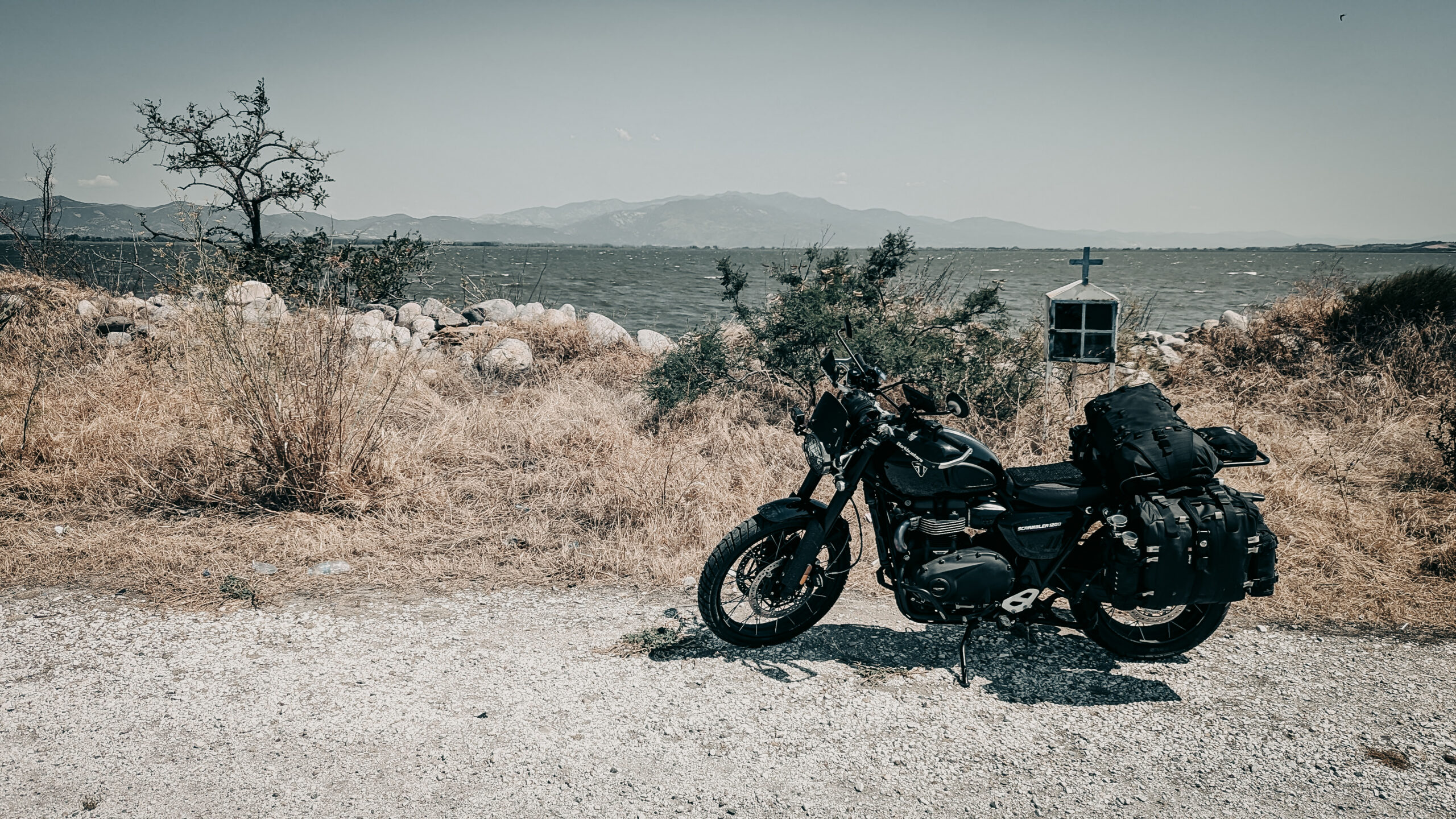
At one point I pulled over next to a small wayside shrine – one of those little glass-fronted boxes on a metal post with a cross on top, a common sight along Greek roads, usually marking the site of an accident or simply a place someone wanted to remember. This one stood alone next to a wide lagoon, with rolling hills fading into the haze on the far shore. The wind was hammering across the water hard enough to bend the dry grass flat against the ground, and the bike, fully loaded with all four bags, looked almost small against that wide, empty view. It’s one of those moments that sums up solo touring for me: no real plan beyond “keep going west,” and a completely unplanned five-minute stop that ends up being the photo I’ll remember the ride by.
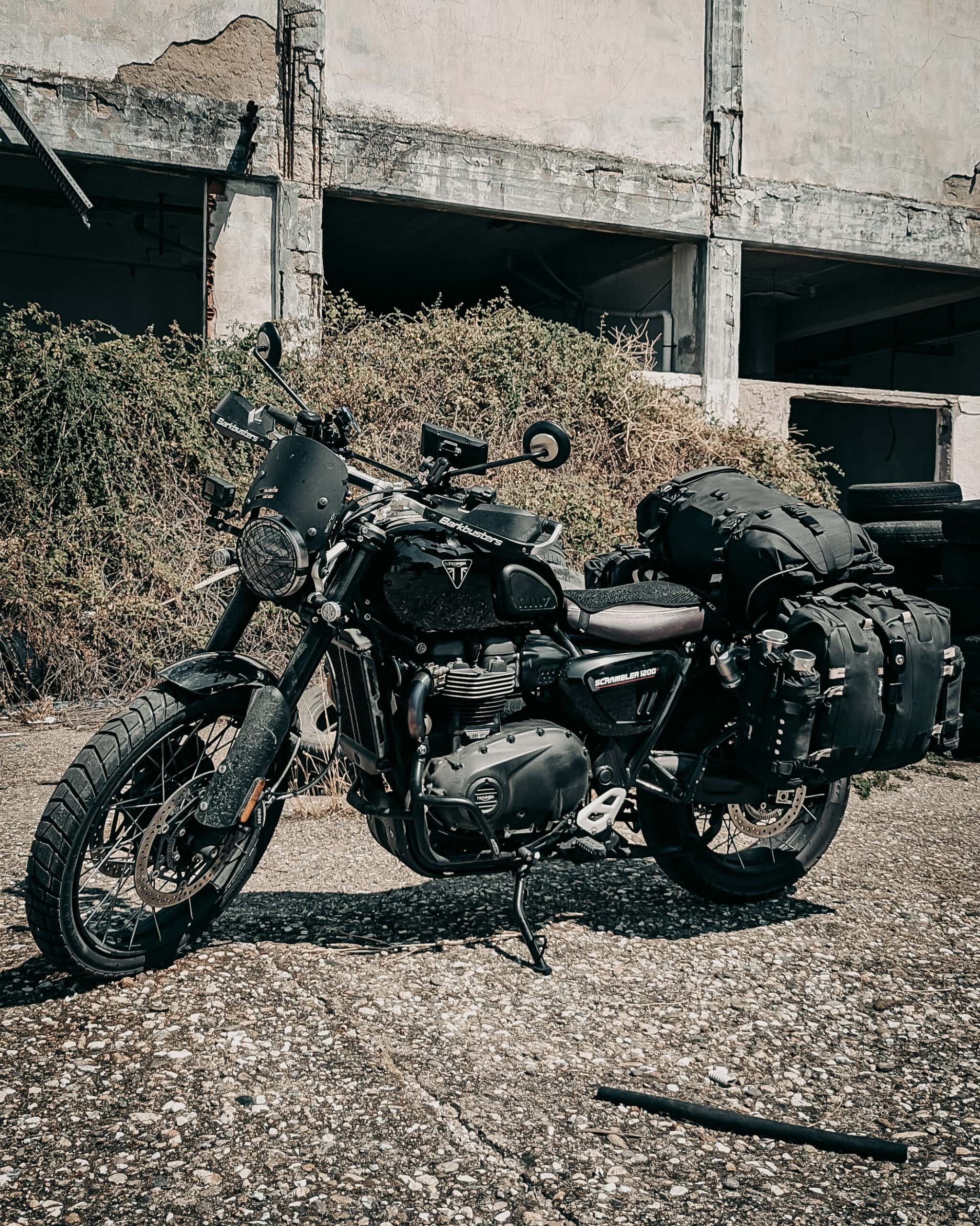
A little further along the route I found something stranger: an abandoned, half-collapsed industrial building, its concrete floors overgrown with dry brush, its open bays stacked high with old discarded tires, the plaster peeling off the walls in big sheets. I parked the Scrambler right in front of it for a photo. The contrast between the packed, ready-to-go motorcycle and the slowly decaying structure behind it felt like an accidental little statement about the trip itself – everything around me either falling apart or fading in the relentless heat, while the bike just kept rolling, day after day, kilometer after kilometer.
The Monastery in the Middle of the Water
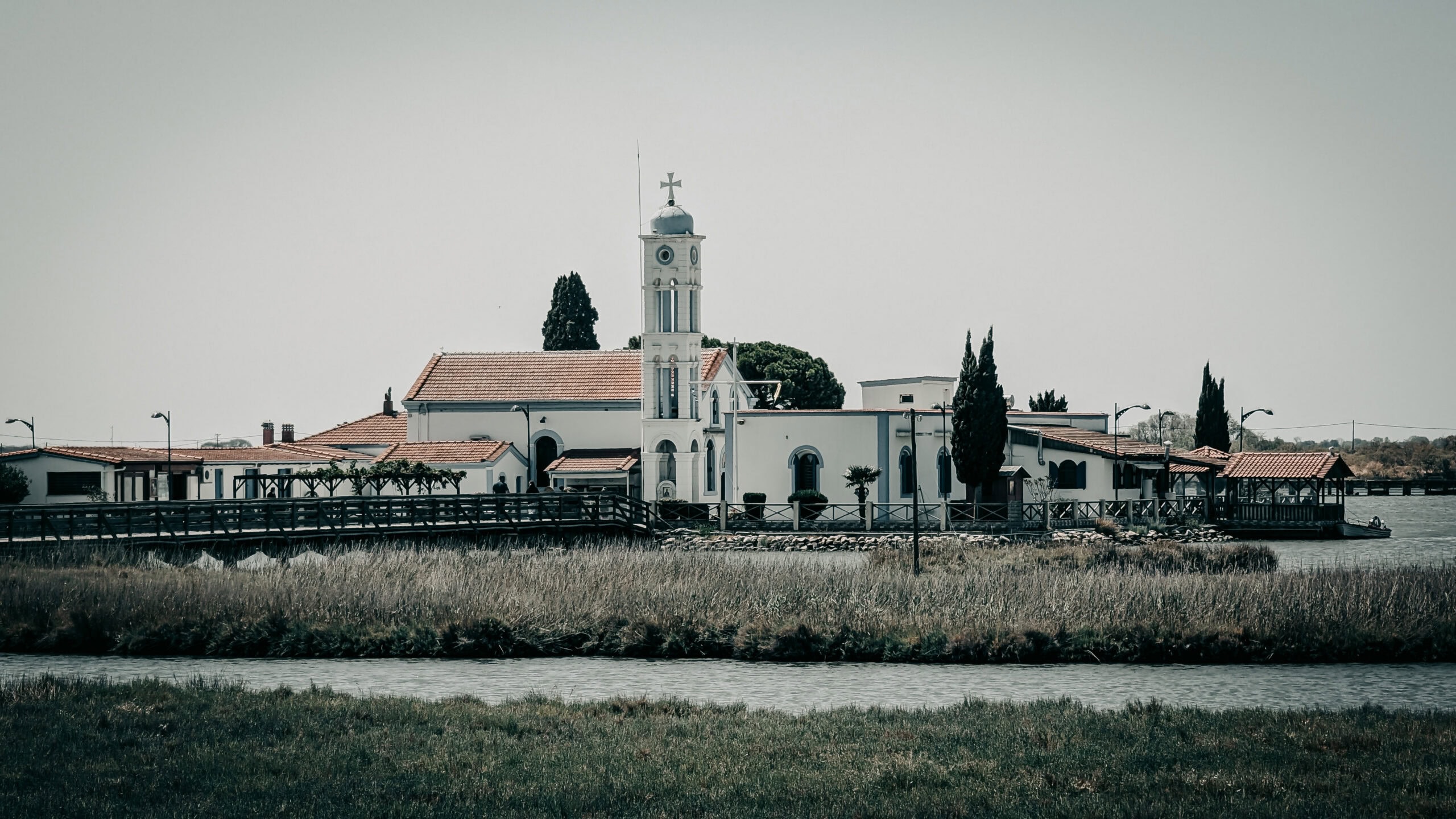
The real highlight of the day arrived without any warning at all. Somewhere inside the Nestos Delta National Park, the road brought me past a small, whitewashed monastery that seemed to be floating on the water itself. I hadn’t planned this stop, hadn’t even known it existed – I simply caught sight of it out of the corner of my eye and had to turn around immediately.
This turned out to be the Agios Nikolaos Monastery near Porto Lagos, a tiny island chapel connected to the mainland by a narrow wooden footbridge stretching maybe a hundred and thirty meters out across the lagoon. The whole complex is almost impossibly picturesque: red-tiled roofs, a slim white bell tower topped with a small dome and a metal cross catching what little light there was, dark cypress trees standing guard around the low buildings like sentries, and dense reed beds all around, reflecting in the flat grey water under an overcast sky. A handful of people were walking slowly across the footbridge toward the church as I arrived, small figures against the white walls and the wide, still lagoon.
I didn’t go inside – I was still in full riding gear, sweating under my jacket, and running on something resembling a schedule – but I stood there at the foot of the bridge for a few minutes just taking it in. There’s something about a place like that, discovered completely by chance from the seat of a motorcycle, that feels more genuine than any landmark you plan a whole day around. No entrance fee, no tour groups, no queue for the perfect photo spot. Just a quiet monastery sitting in the middle of a national park, found because I happened to glance sideways at exactly the right moment on an otherwise unremarkable stretch of road.
If I’m honest, this one accidental stop did more for me than half a day of planned sightseeing usually does. It’s exactly the kind of moment that makes me want to keep riding the smaller roads instead of the motorway, even when it takes longer – you simply see more, and you see it on your own terms.
Rolling Into Thessaloniki
From the monastery it was a straightforward run further west into Thessaloniki. I’d booked a really nice Airbnb apartment for what I planned as a proper rest day there – a genuine chance to be a tourist for once instead of just passing through another town on the way to somewhere else. The plan was simple enough on paper: arrive in the evening, settle in, and spend the following full day exploring the city properly.
Except the arrival didn’t go quite as planned. The Airbnb listing clearly advertised an underground parking spot as part of the deal, but when I actually got there in the evening, there was none to be found. Nothing. No attendant, no gate, no space reserved for me – just an empty promise in the listing text. I went looking for alternatives, checking with a couple of nearby parking garages within walking distance of the apartment, only to find out that none of them allow motorcycles inside at all. Cars only, apparently, even in a city that’s absolutely full of scooters and motorbikes weaving through traffic all day long.
So I did what I had to do: found a spot on the street a short walk from the building, locked the Scrambler with a chain around a fixed post, and pulled the rain cover over the whole bike so it wasn’t immediately recognizable as anything worth the effort of stealing. This was the first time on the entire route – over more than two weeks and thousands of kilometers by that point – that I had to leave the bike somewhere that felt genuinely unsafe.
Realistically, I know it was probably fine. There were plenty of other motorcycles parked along that same stretch of street, nobody seemed to think twice about leaving their bikes out overnight, and Thessaloniki isn’t exactly known as a hotspot for motorcycle theft. But when it’s the first time, and it’s your own bike, loaded with everything you own for weeks on the road, rational arguments only help so much. I went to bed that night more aware of every noise drifting up from the street than I would ever admit to anyone back home.
A Georgian Dinner and a Night Grateful for Air Conditioning
Once the bike was as secured as it was ever going to get, I pushed the worry aside and went out for an evening walk to see a bit of the city and find something to eat. I wandered without much of a destination in mind and eventually ended up in a small restaurant tucked into a quiet courtyard, run by a Georgian owner. The food was excellent and came in genuinely generous portions – exactly what you want after a long, hot day in the saddle followed by a stressful parking search. I ate very well that evening, probably more than I should have, and enjoyed every single bite of it.
The rest of the evening I spent back at the Airbnb, and for once in this trip I was genuinely, deeply grateful for a functioning air conditioner. Temperatures on this stretch of the route have been consistently above 35°C during the day, and the nights barely bring any real relief – it stays uncomfortably warm well past midnight, the kind of heat that makes sleeping with the windows open impossible. Sitting in a properly cooled apartment after a day like that felt like an unreasonable luxury, and I made full use of it before finally calling it a night.
The Next Day: Getting to Know Thessaloniki
With the bike parked, chained, covered, and – as far as I could tell in the morning light – completely untouched, I finally had a real day off to actually explore. I was staying right in the center of the city, close to the market square, and I made full use of the location.
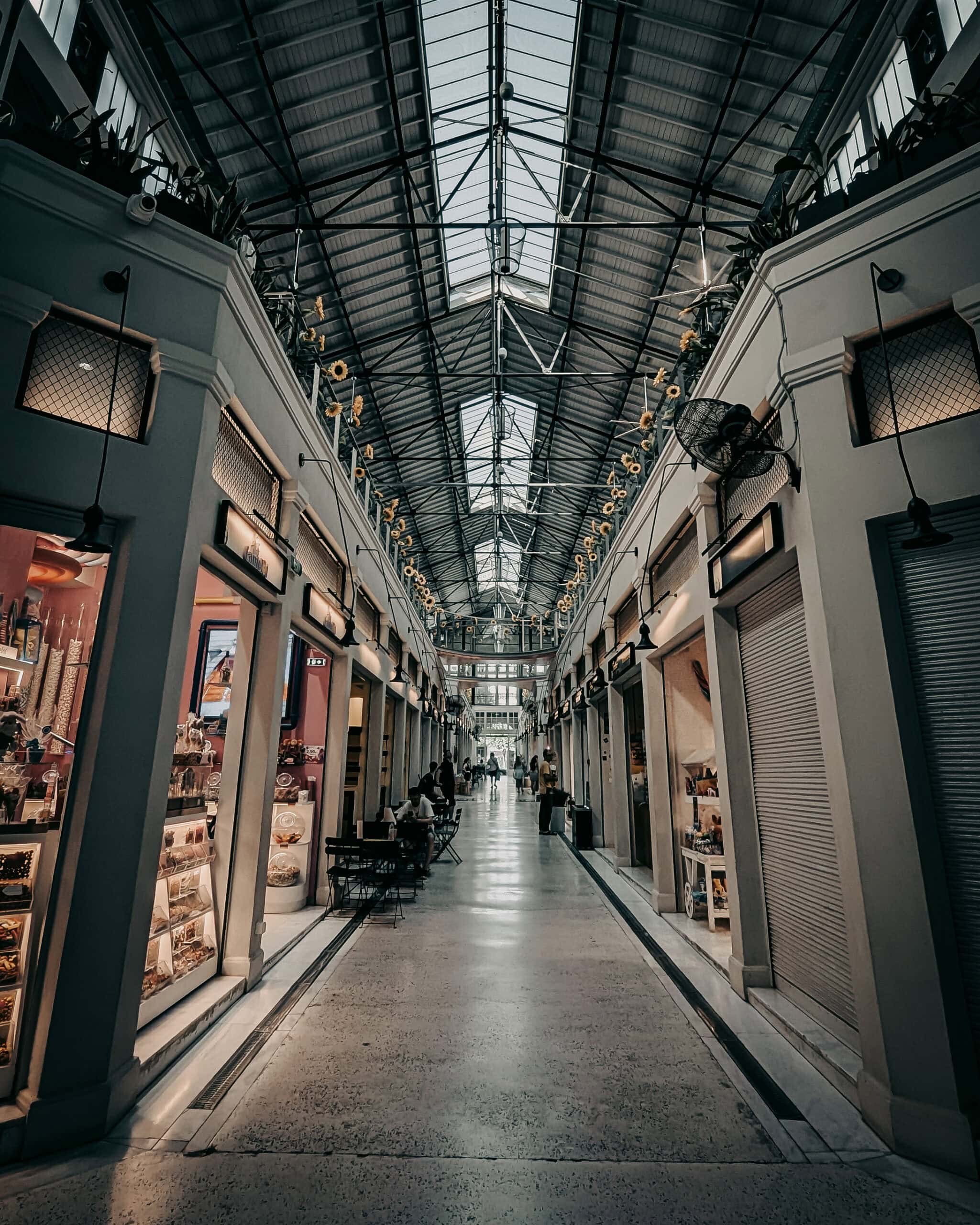
My first real stop was the covered market arcade near the center of town – a long, glass-roofed passage lined with little shops on both sides, sunflower garlands strung along the black steel rafters overhead, ceiling fans turning slowly against the midday heat. Old-fashioned storefronts sat side by side, a few people were seated at small café tables in the shade, and daylight came down through the skylights in long, soft columns that lit up the polished floor. It’s the kind of place that feels almost timeless, and after so many days of highways, border checkpoints, and toll booths, it was a genuinely pleasant change of pace to just wander slowly through it with no particular goal in mind.
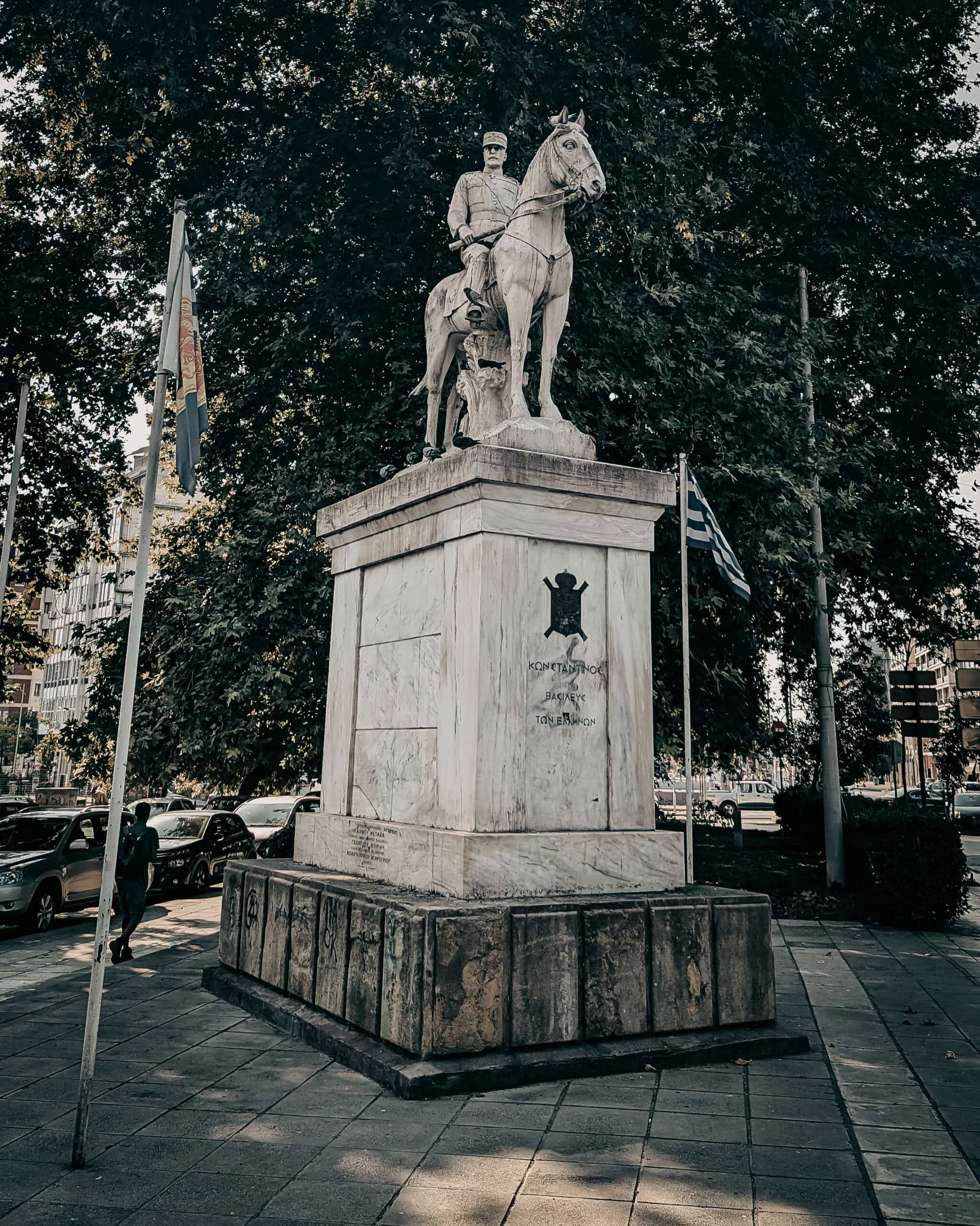
From there I walked toward the waterfront and came across the impressive equestrian statue of King Constantine I, sitting high on his horse atop a weathered marble pedestal, framed by tall shade trees with a Greek flag hanging beside him and cars streaming past in the background. It’s one of those monuments you could easily walk past without a second glance, until you actually look up and realize how much history is standing there quietly in the middle of ordinary city traffic.
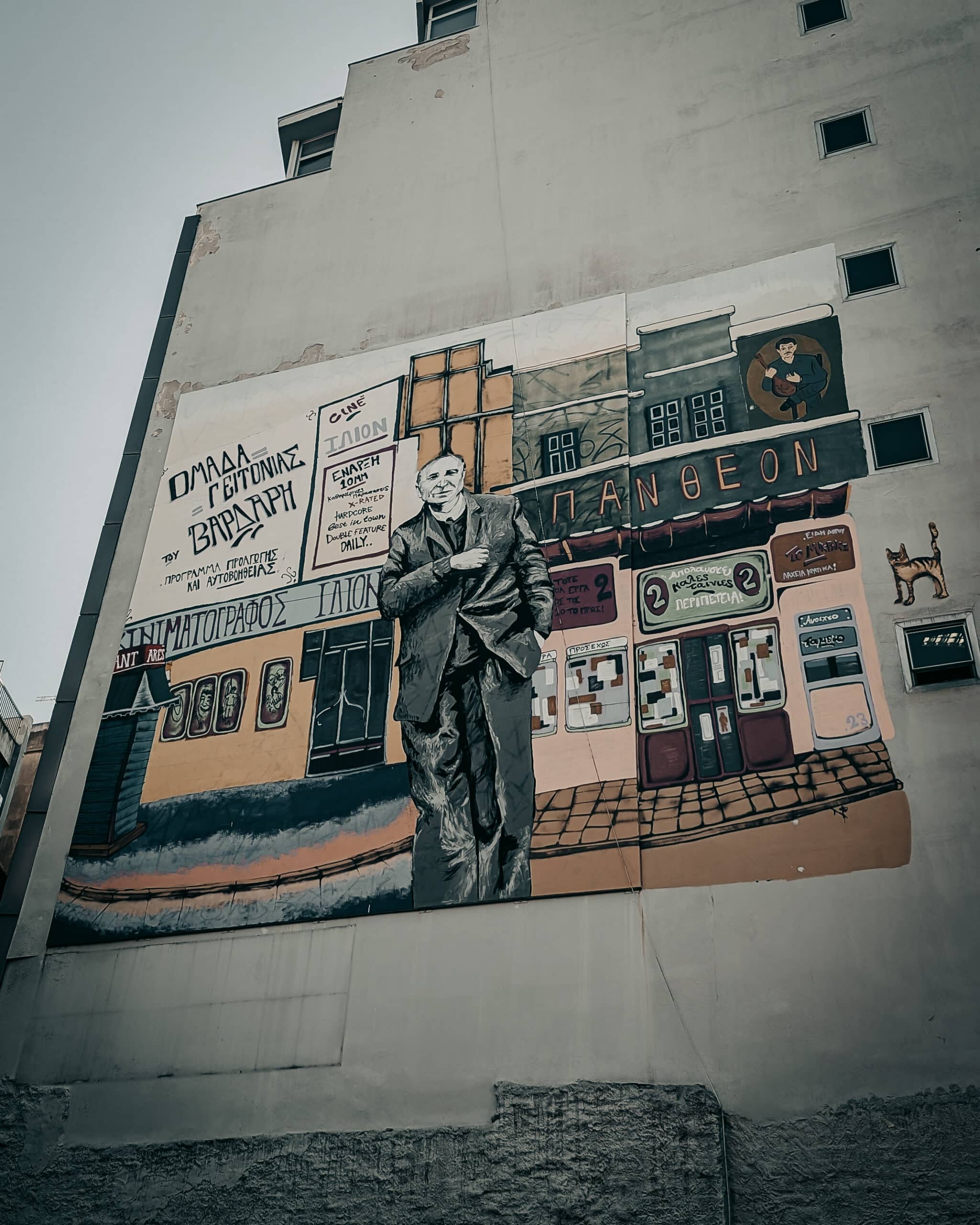
The part of the city I found most interesting, though, was the Vardari district, the older, rougher-edged part of town near the market. There’s a huge mural covering the entire side of a multi-story building there – a black-and-white painted figure of a man in a suit, standing in front of a beautifully recreated old cinema façade, complete with hand-painted movie posters, the word “ΠΑΝΘΕΟΝ” (Pantheon) written across a fake striped awning, a smaller portrait of a musician tucked into a corner window, and even a small orange cat painted onto the wall beside it. It’s a tribute to the neighborhood’s cinema history and its old “Ilion” movie theater, and it’s genuinely impressive in scale – you have to crane your neck all the way back just to take in the whole thing from the narrow street below.
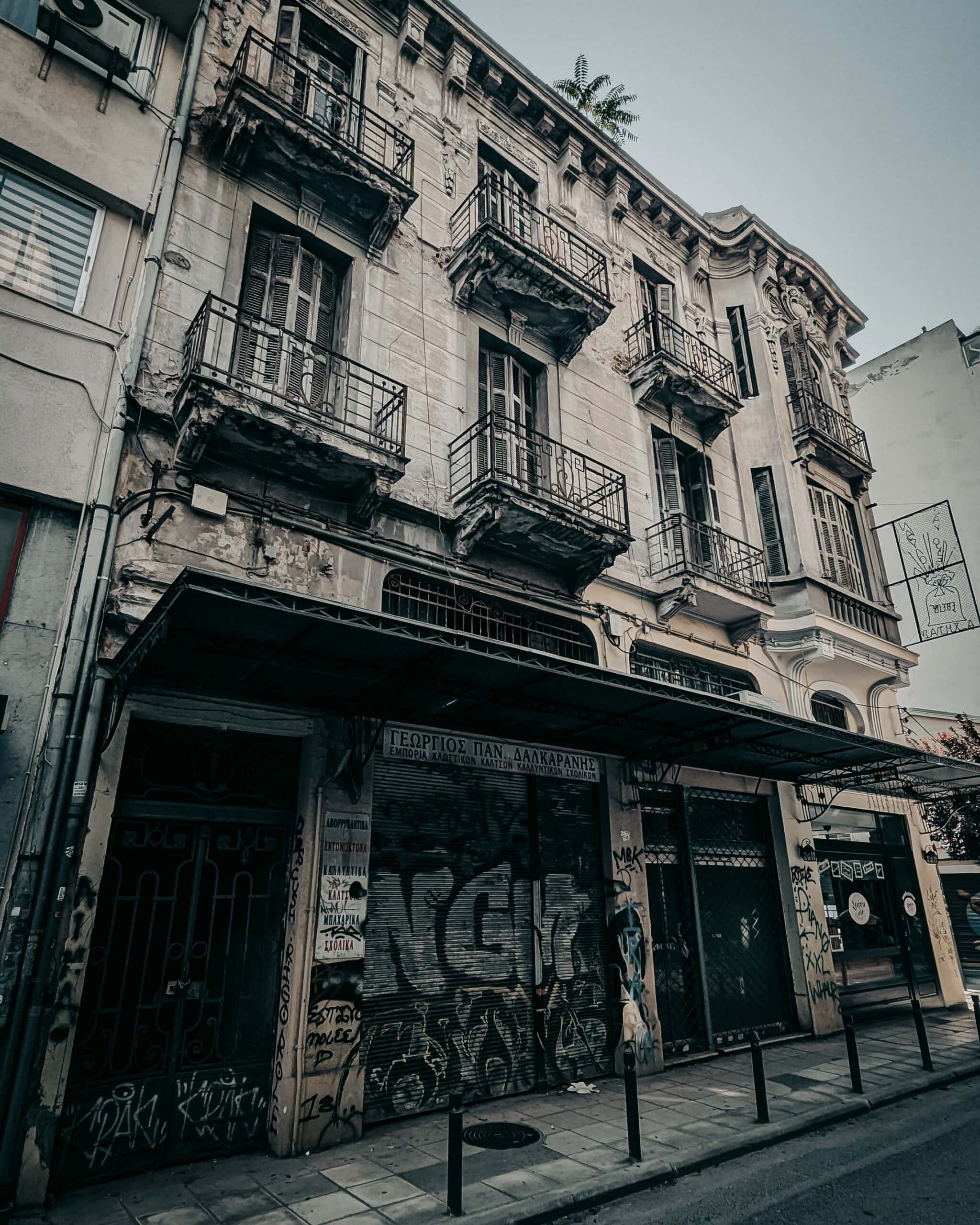
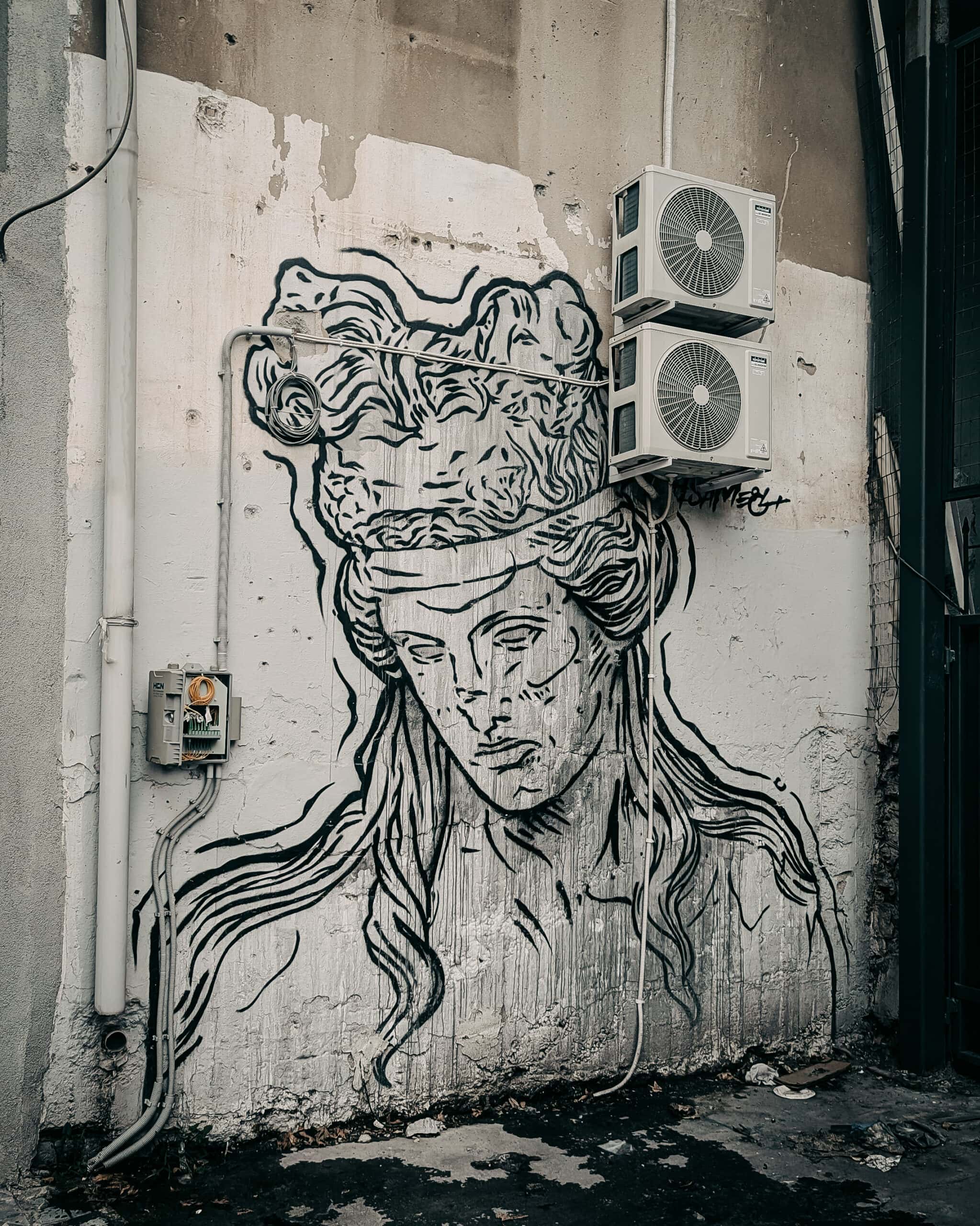
Just around the corner, the buildings tell a very different, far less polished story: faded, crumbling façades with wrought-iron balconies rusting and sagging at the edges, shuttered storefronts covered in thick layers of graffiti, and old hand-painted shop signs still hanging above doors that clearly haven’t opened in years, if not decades. It’s not the pretty postcard version of Thessaloniki you’d find in a travel brochure, but it has far more character than most polished old towns I’ve ridden through on this trip. In a quiet alley nearby, someone had spray-painted a striking black-and-white mural of a classical Greek statue’s head directly onto a weathered, patched wall – and the artist had cleverly worked two boxy air-conditioning units mounted on the wall right into the design, positioning them exactly where the figure’s ear would be. Small, unexpected details like that are exactly what make wandering a new city on foot so much more rewarding than simply seeing it from the seat of a motorcycle.
Looking Back on Day 16
This turned out to be a day that had a bit of everything: quiet backroads winding through Thrace, a monastery I found completely by chance and won’t forget anytime soon, a parking situation that tested my nerves for the first time on this whole trip, an excellent Georgian dinner, a night saved by air conditioning, and then a full, unhurried day of simply getting to know a beautiful, slightly rough-around-the-edges Greek city. Thessaloniki didn’t need any convincing to win me over – between the covered market, the statue on the waterfront, the murals and crumbling charm of Vardari, and the heat that never really let up day or night, it earned its place as one of the stops I’m genuinely glad I built an extra day around.
There’s also something worth noting about the rhythm of a trip like this: after the drama of the last several days – the engine warning that sent me back to Bucharest, the three-hour border wait into Turkey, the long, hot ride out of Istanbul – a day built around a rest stop can end up being just as memorable as the “big” travel days, just for completely different reasons. Nobody plans to remember a random monastery glimpsed from the road, or a chained-up motorcycle under a rain cover, or a mural of a man in a suit walking past a fake cinema. But those are exactly the details that stick.
Next up: continuing west, further along the road that’s slowly, steadily leading me back toward home.