
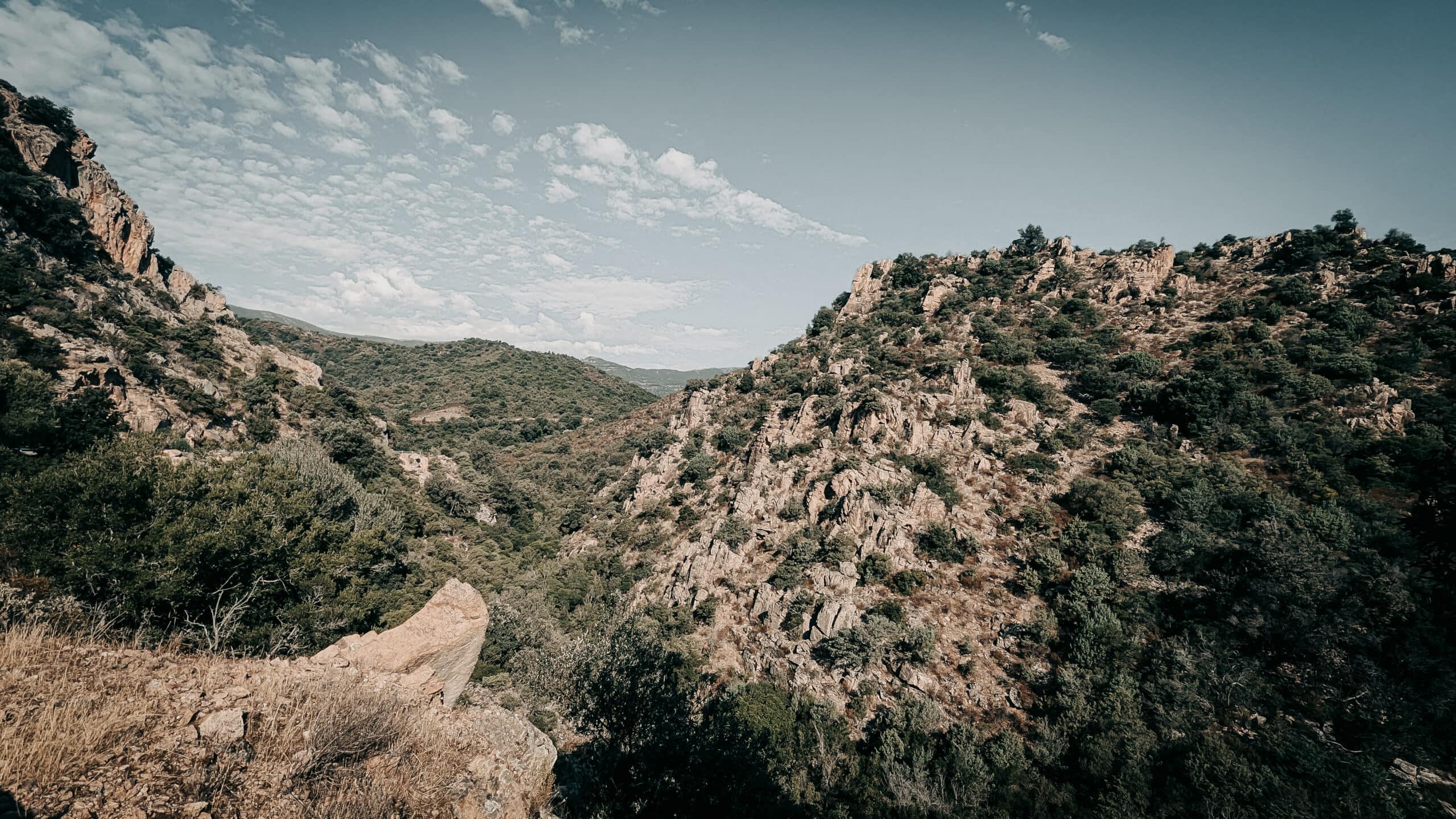
I woke up in my little accommodation just outside Santa Maria Navarese with one clear goal for the day: reach the north of Sardinia. Not because there was anything urgent waiting for me up there, but because the ferry to Corsica was leaving from Santa Teresa Gallura the following morning, and I wanted to already be standing at the departure point the night before rather than racing there at dawn. That meant a long day in the saddle — Sardinia is bigger than it looks on the map, and the north was still a good stretch away.
The plan for Day 25 was simple: get north, and get there with time to spare. But simple plans on this island rarely translate into simple riding, and this day was no exception. Instead of taking the fastest coastal route, I pointed the bike inland again, back up into the hills, because the map showed a pass road cutting straight through the heart of the Parco Nazionale del Golfo di Orosei e del Gennargentu — and after the Seven Brothers the day before, I’d learned that these interior roads in Sardinia are almost always worth the detour, even when they add an hour or two to an already long day.
I packed up quietly, said goodbye to the little accommodation that had treated me so well the night before, and rolled out onto the coast road while the air still had that early, slightly cool edge to it that disappears completely by mid-morning in Sardinia in August. Within a few kilometers the road had already started climbing, and the sea disappeared behind me in the mirrors, replaced by rock and pine. There’s a particular satisfaction in leaving a place you genuinely enjoyed while it’s still quiet, before the day’s tourists are up and the streets fill in — just you, the bike, and a long, mostly empty road ahead.
Back Into the Mountains
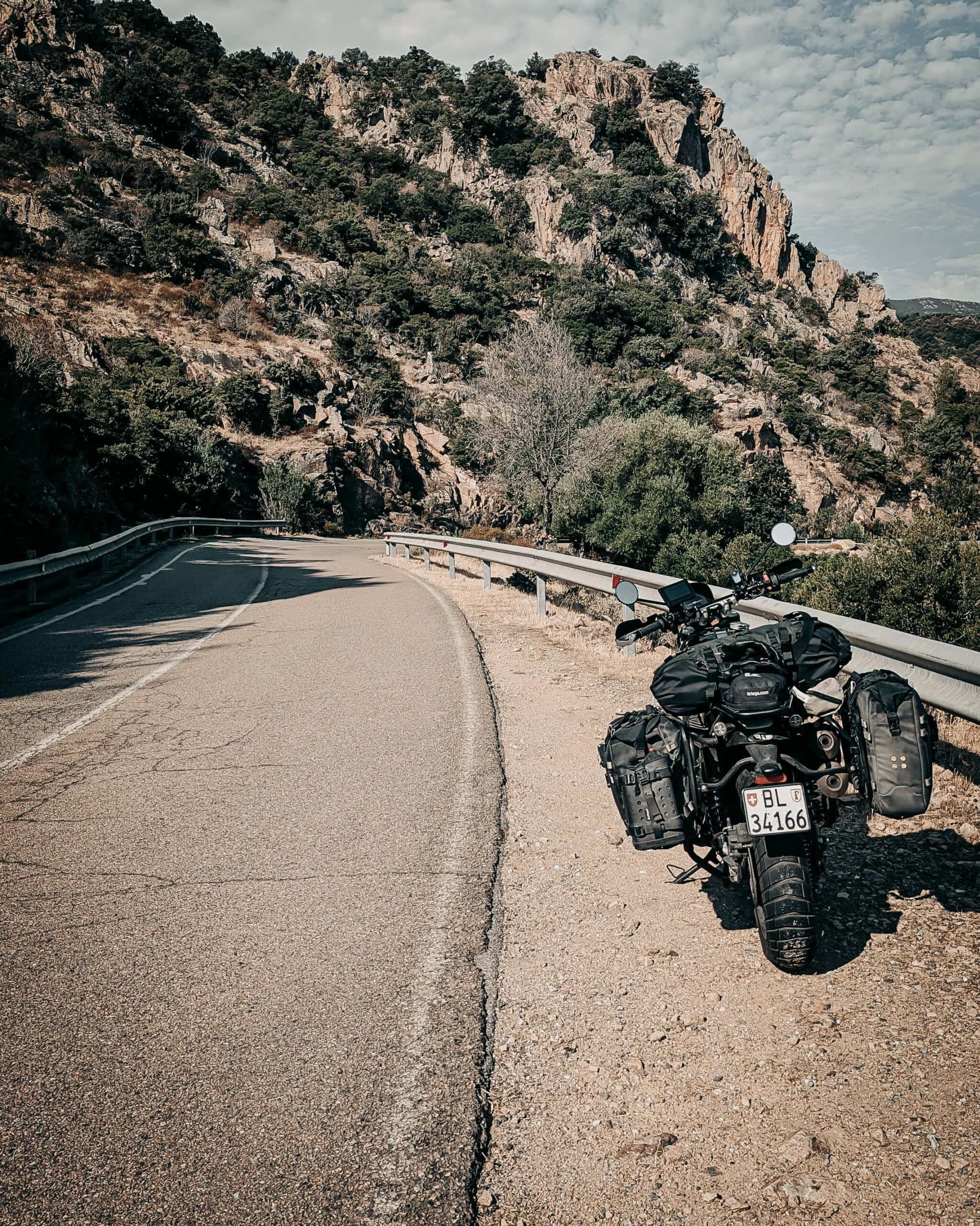
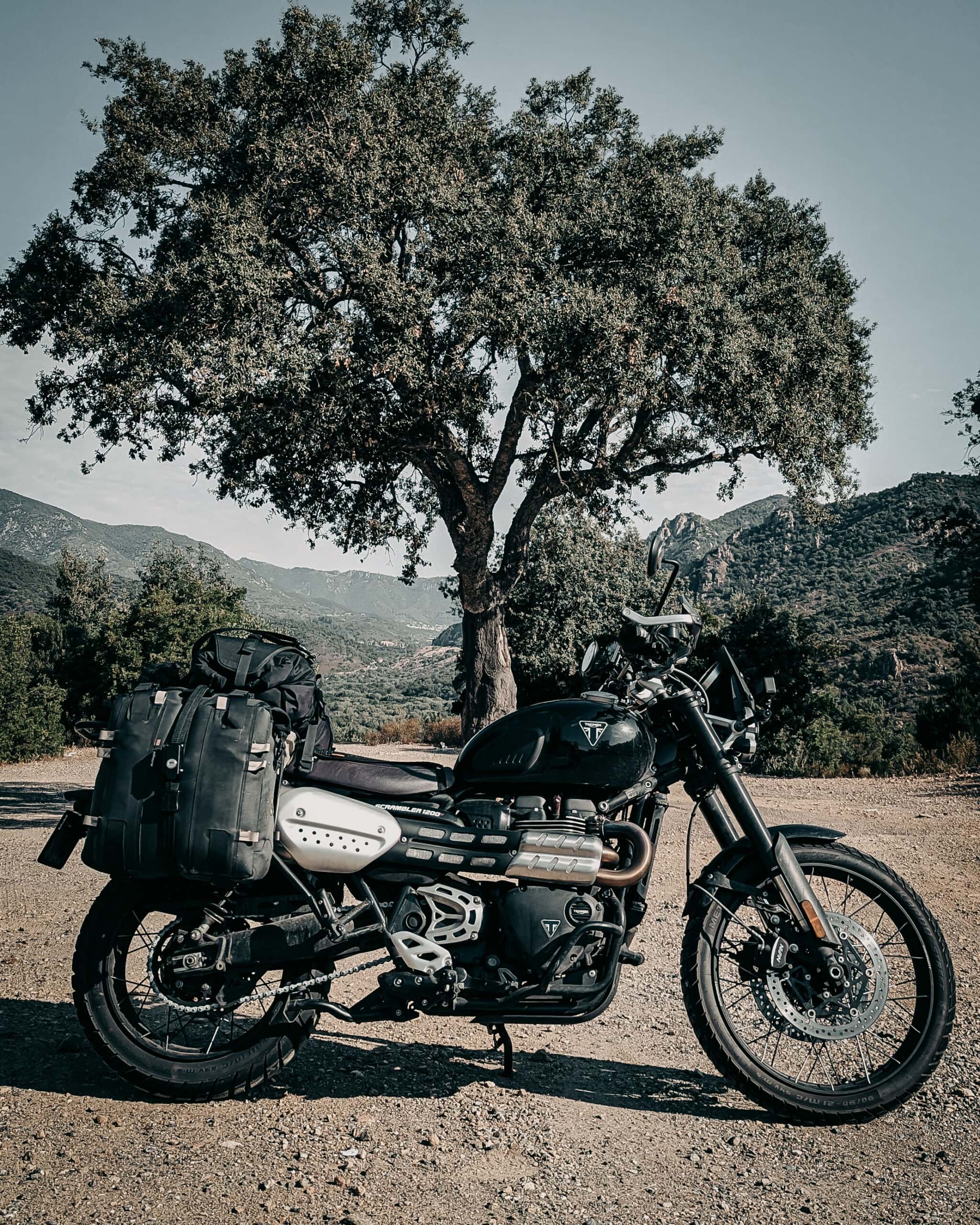
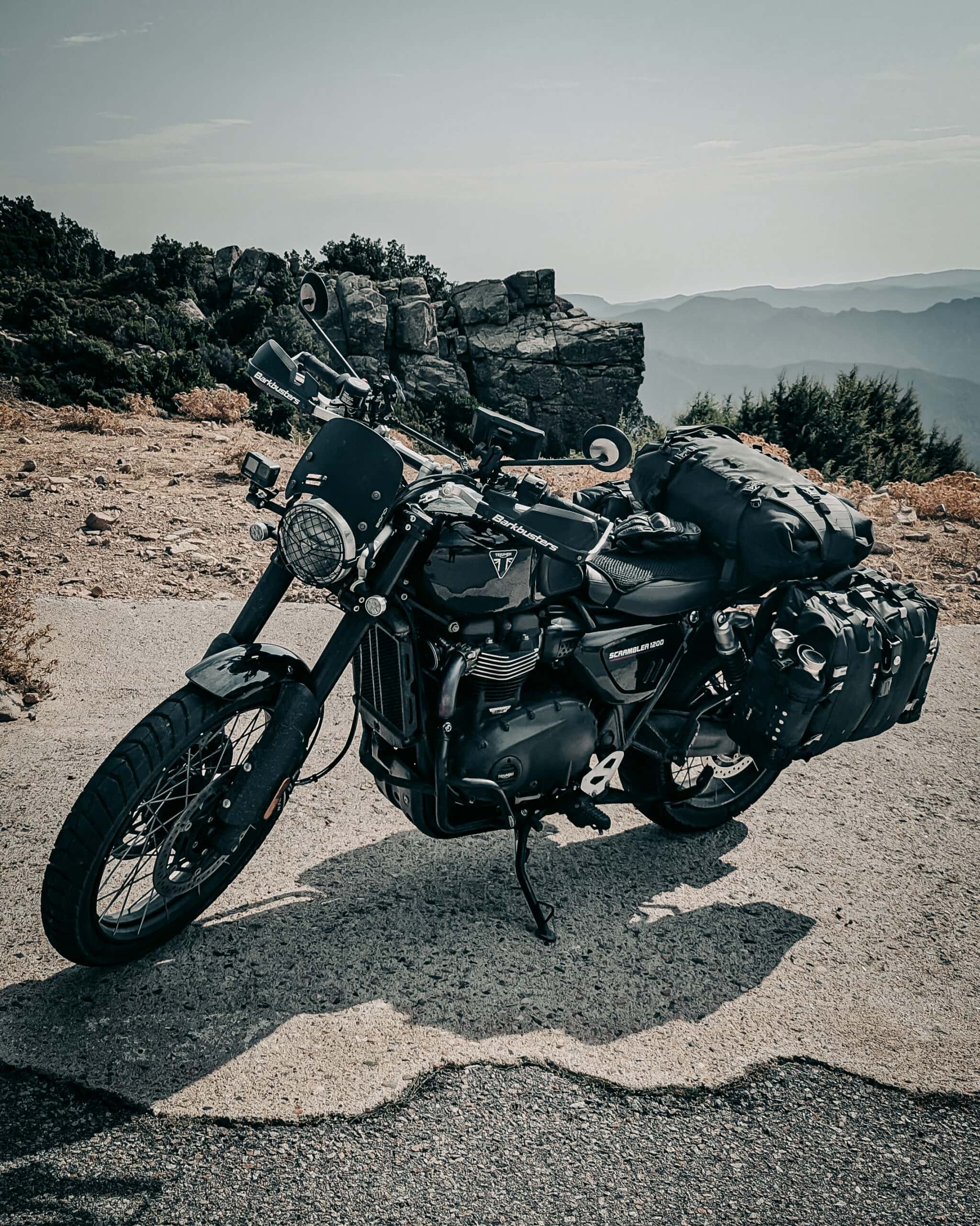
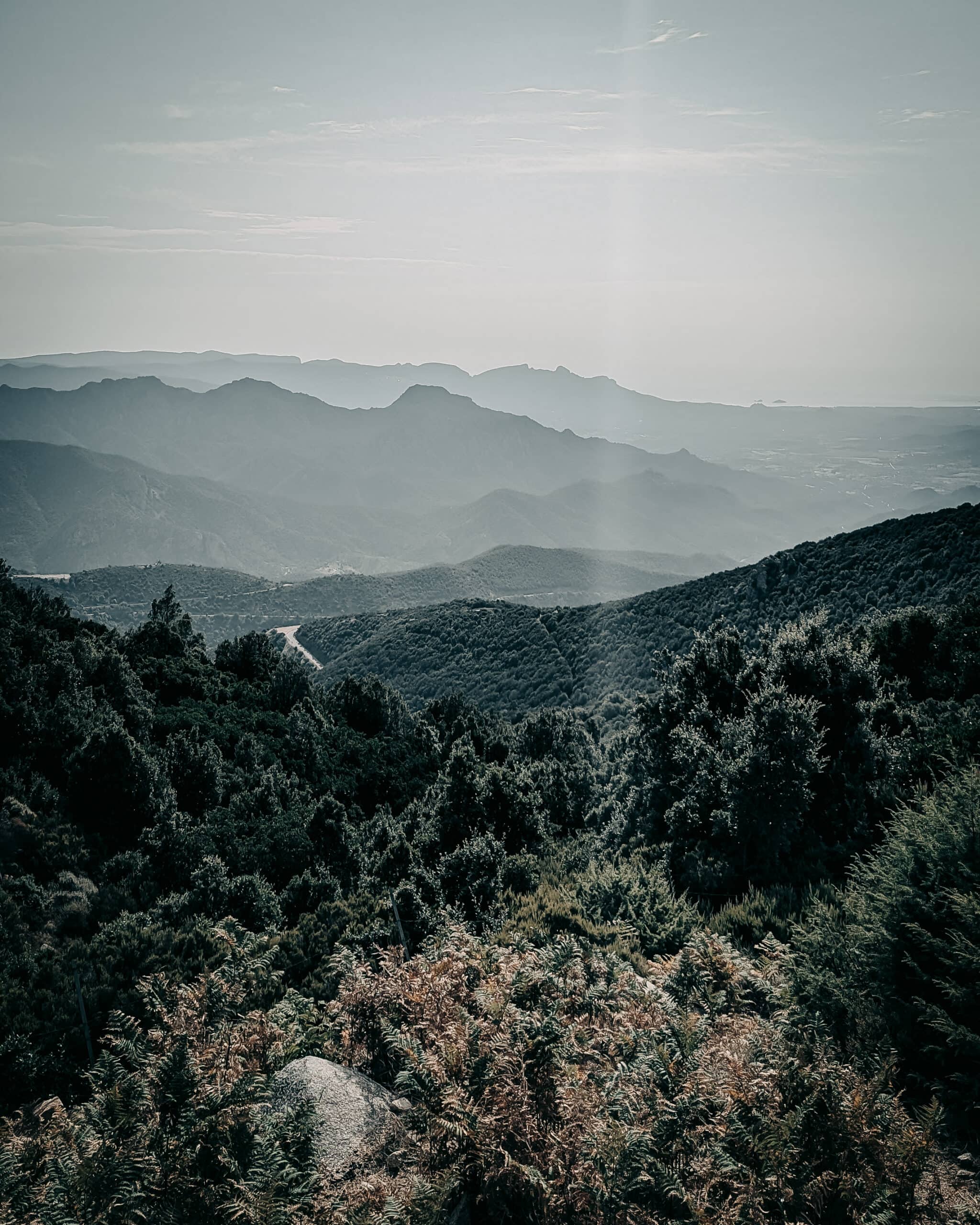
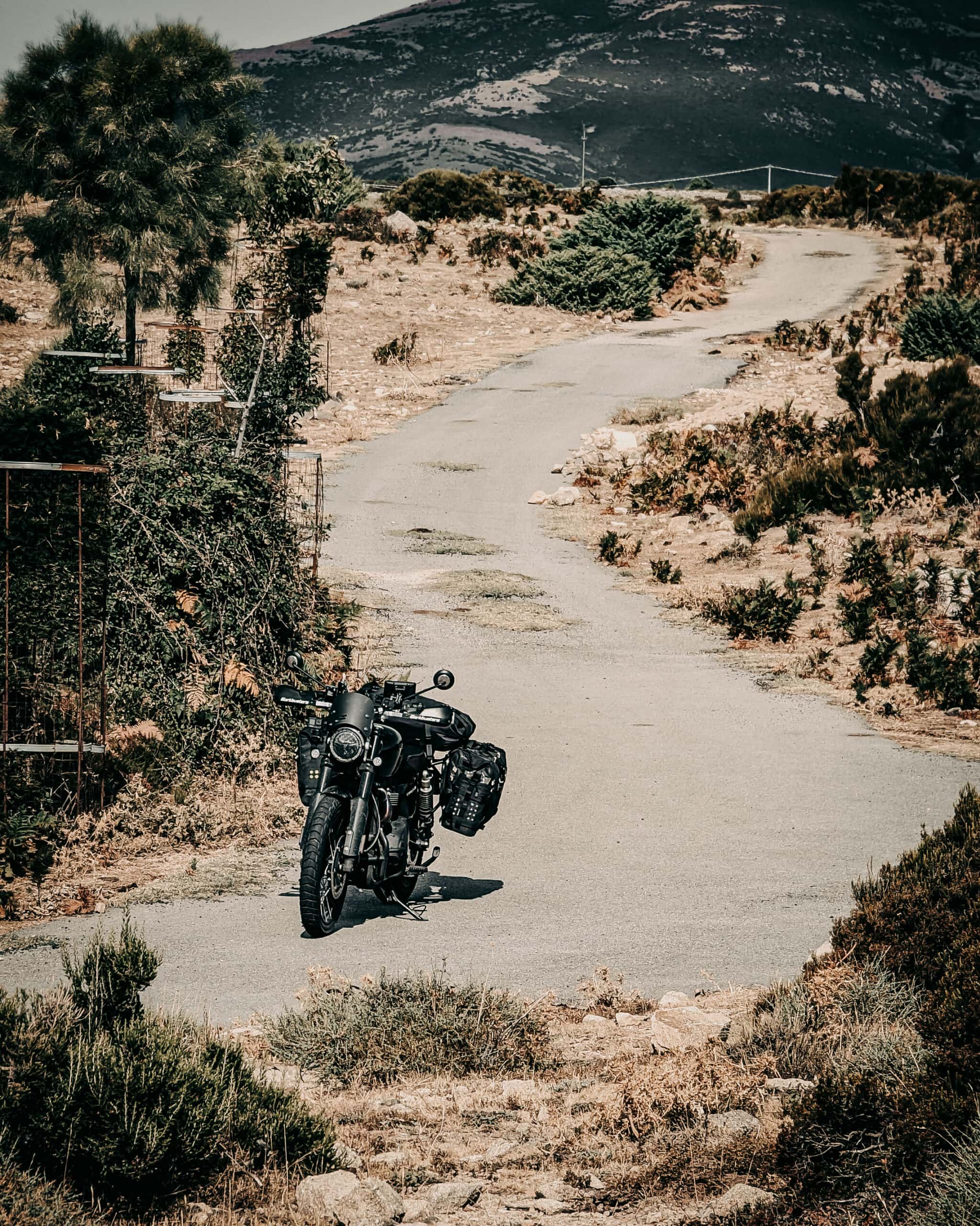
Leaving Santa Maria Navarese, the road climbed almost immediately, winding up into a landscape of bare granite peaks and dense green scrub. I’d expected something scenic, but I hadn’t expected quite how remote it would feel. This pass road turned out to be one of the loneliest stretches I’ve ridden on the entire trip — long sections without a single house, without a single other vehicle, just rock, forest, and sky stretching out in every direction. At one overlook I stopped just to take it in: layer after layer of mountain ridges fading into haze toward the horizon, the road itself barely visible as a thin pale line disappearing into the valley below. A narrow strip of asphalt cut through dense pine and juniper cover, hugging the contour of the hillside before vanishing around a shoulder of rock further along.
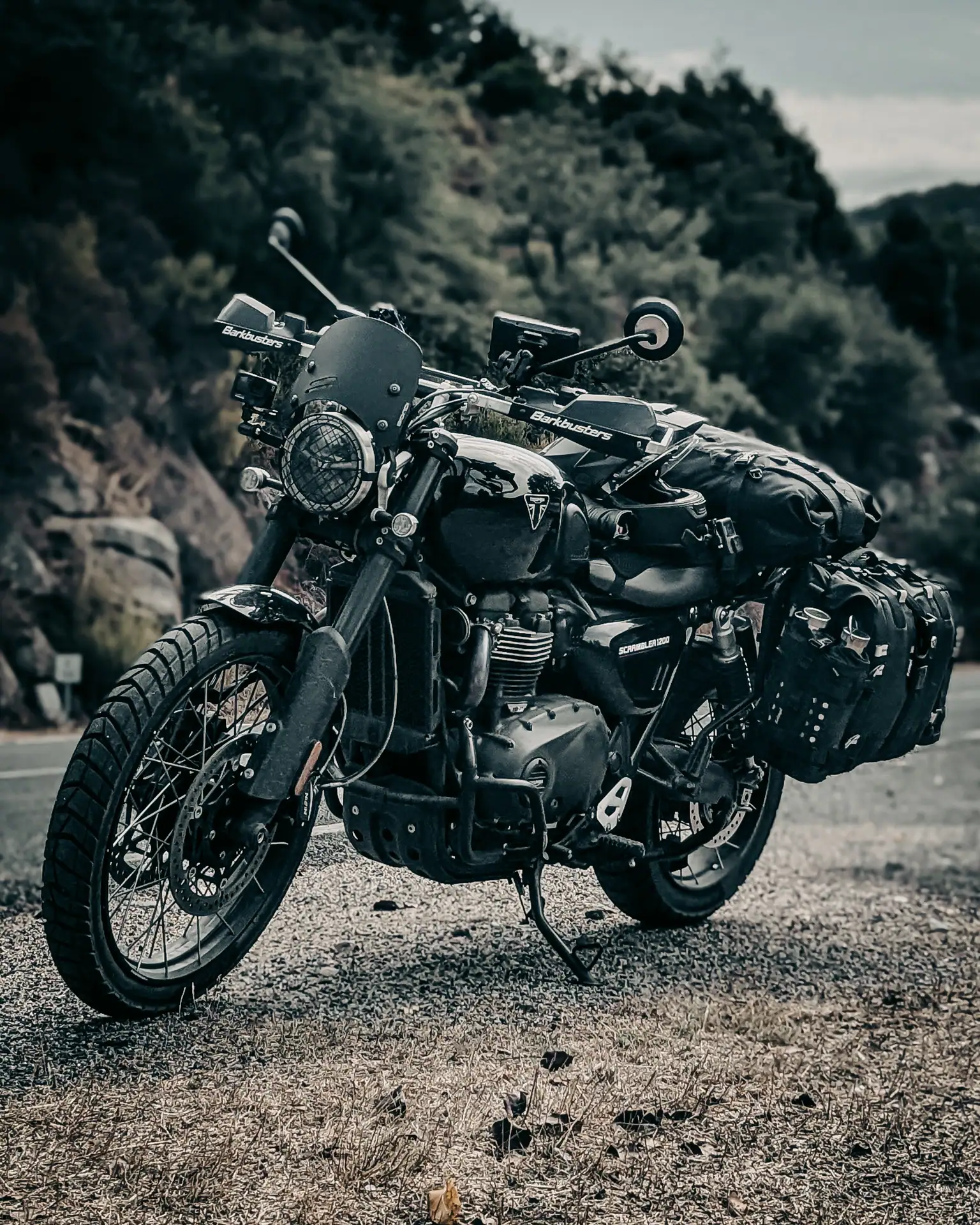
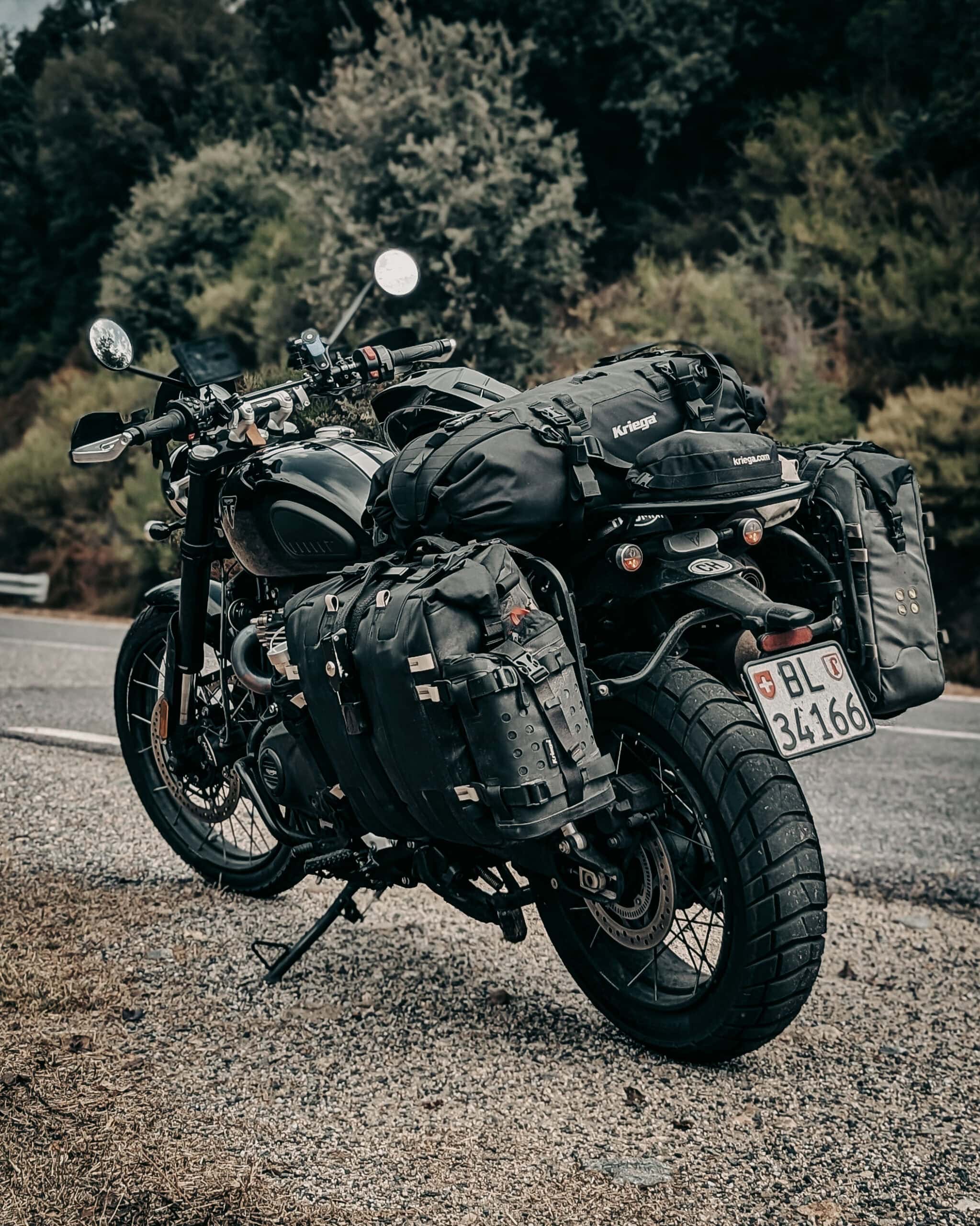
What really caught me off guard, though, were the animals. Around a bend, I came across a small group of donkeys standing calmly in the middle of the road, completely unbothered by my approach. A little further on, a couple of horses were grazing right at the roadside, close enough that I slowed to a crawl just to be safe. There was nobody around — no farmer, no fence, no sign explaining where they’d come from. They were simply there, part of the landscape, as if the mountains had always belonged to them and the tarmac was just something that had been added later. It gave the whole ride an oddly timeless feeling, like I’d slipped a few decades backward without noticing. I’ve ridden through plenty of remote regions on this trip, but there was something about a mule standing squarely in the middle of a state road, entirely unfazed by a loaded-down Scrambler rolling toward it, that summed up the pace of life out here better than any guidebook could.
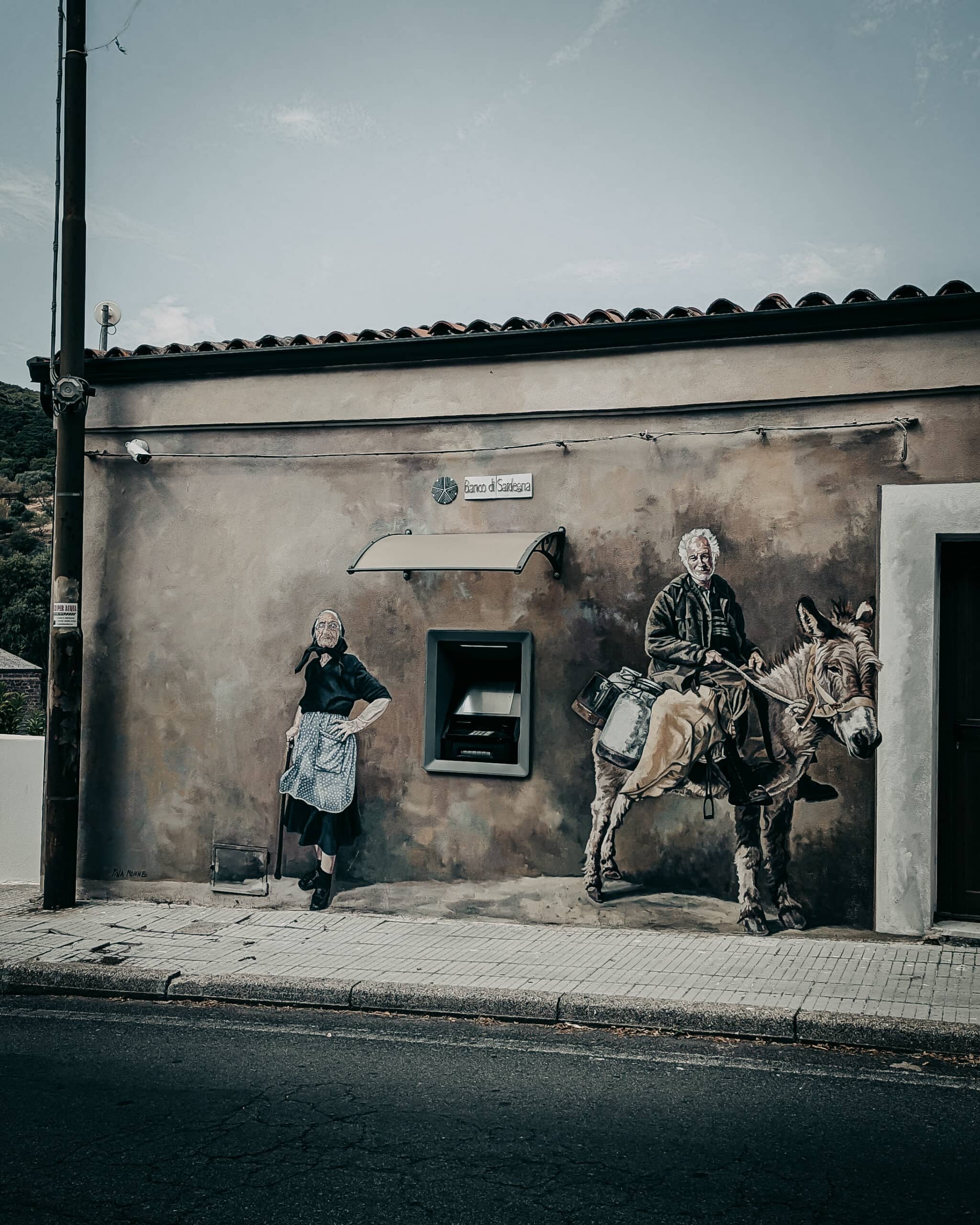
That feeling was reinforced later in the day when I stopped for photos at a mural I passed in one of the villages along the way — a painting on the side of a bank building showing an old woman in traditional dress standing next to an ATM, and further along the same wall, an elderly man riding a donkey loaded with milk canisters. It’s a clever piece of street art, playing on the contrast between old Sardinia and new, with the cash machine slotted neatly between the two painted figures as if it had always belonged there. But after what I’d just seen on the mountain road, it didn’t feel like a joke so much as a fairly accurate summary of the day — old and new Sardinia, standing right next to each other, neither one particularly bothered by the other.
A Roadside Shrine and a Strange Monument
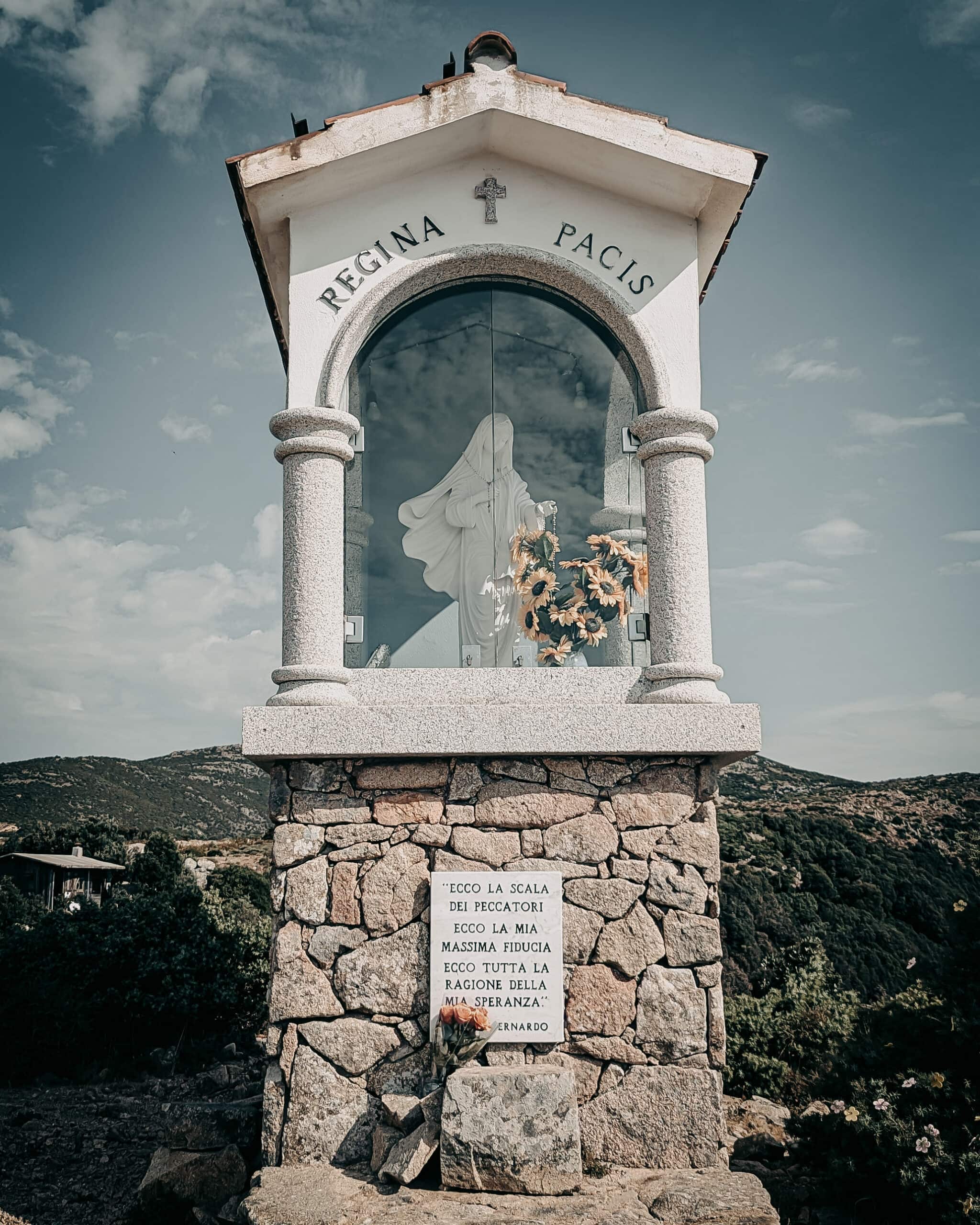
Sardinia’s back roads are full of small, unexpected things if you’re willing to stop for them, and this pass road delivered two in quick succession. The first was a little roadside shrine, a whitewashed stone structure with the words “Regina Pacis” carved above an arched glass case. Inside stood a statue of the Virgin Mary, a fresh bunch of sunflowers placed at her feet, with a small plaque below quoting a prayer in Italian about hope and trust. These shrines turn up all over rural Italy, but this one, perched alone on a mountain pass with nothing but rock and scrub around it, felt particularly striking — someone clearly still comes by regularly enough to keep the flowers fresh, which meant somewhere nearby, however empty the landscape looked, people still lived and still made the effort.
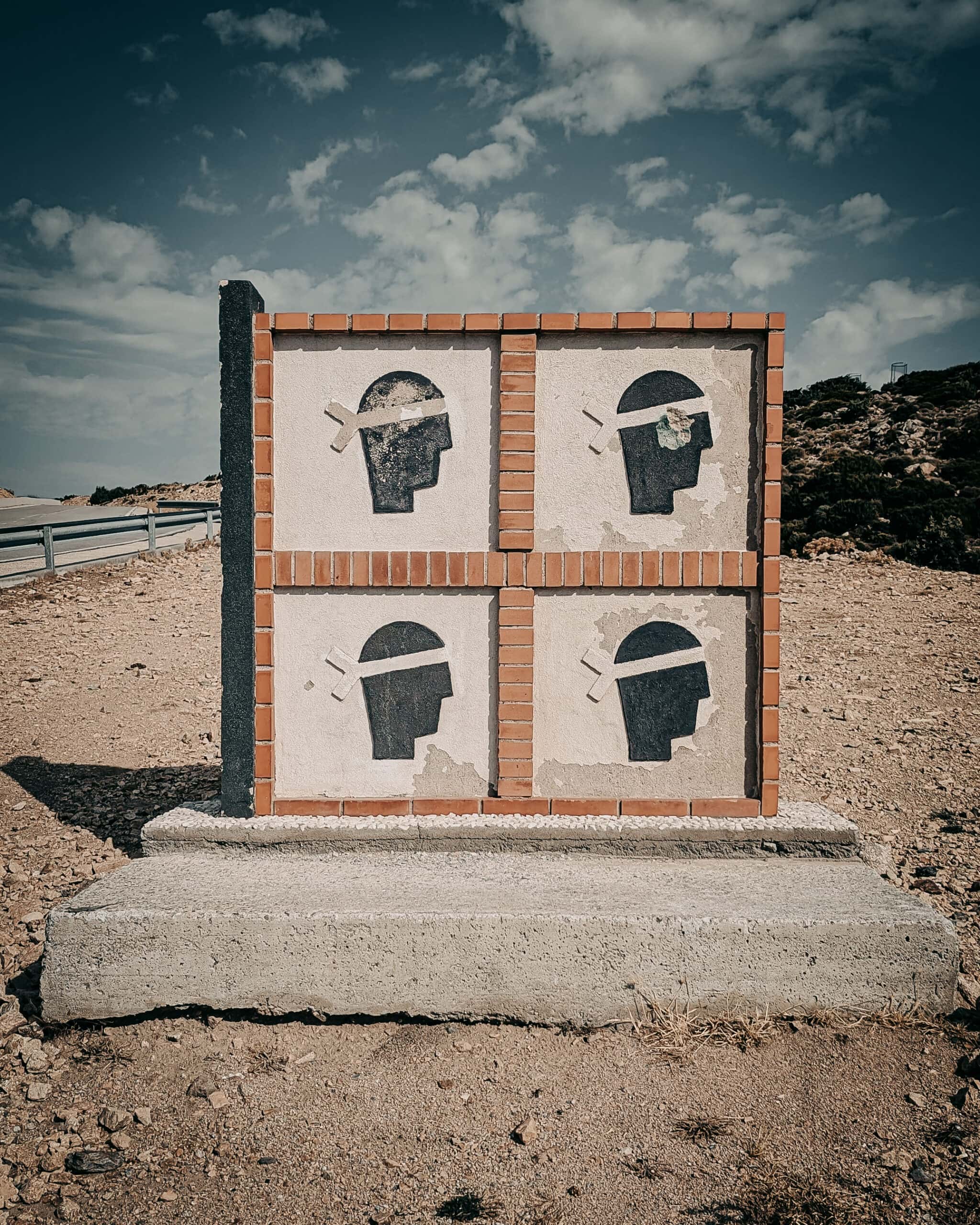
The second stop was considerably stranger: a square brick-framed monument standing right at the edge of the road, split into four panels, each showing a stylized black silhouette of a head wrapped in a white blindfold. I have no idea what it commemorates — there was no explanatory sign, nothing beyond the four faces staring out in different directions from their little frames, weathered and chipped from what must have been years of sun and wind out here with no shelter at all. It’s the kind of roadside oddity that makes solo touring worthwhile: you’ll never fully understand the story behind it, but you get to carry the image with you anyway, another small piece of a place you passed through once, filed away without a caption.
Through the Hills and Down to the Lake
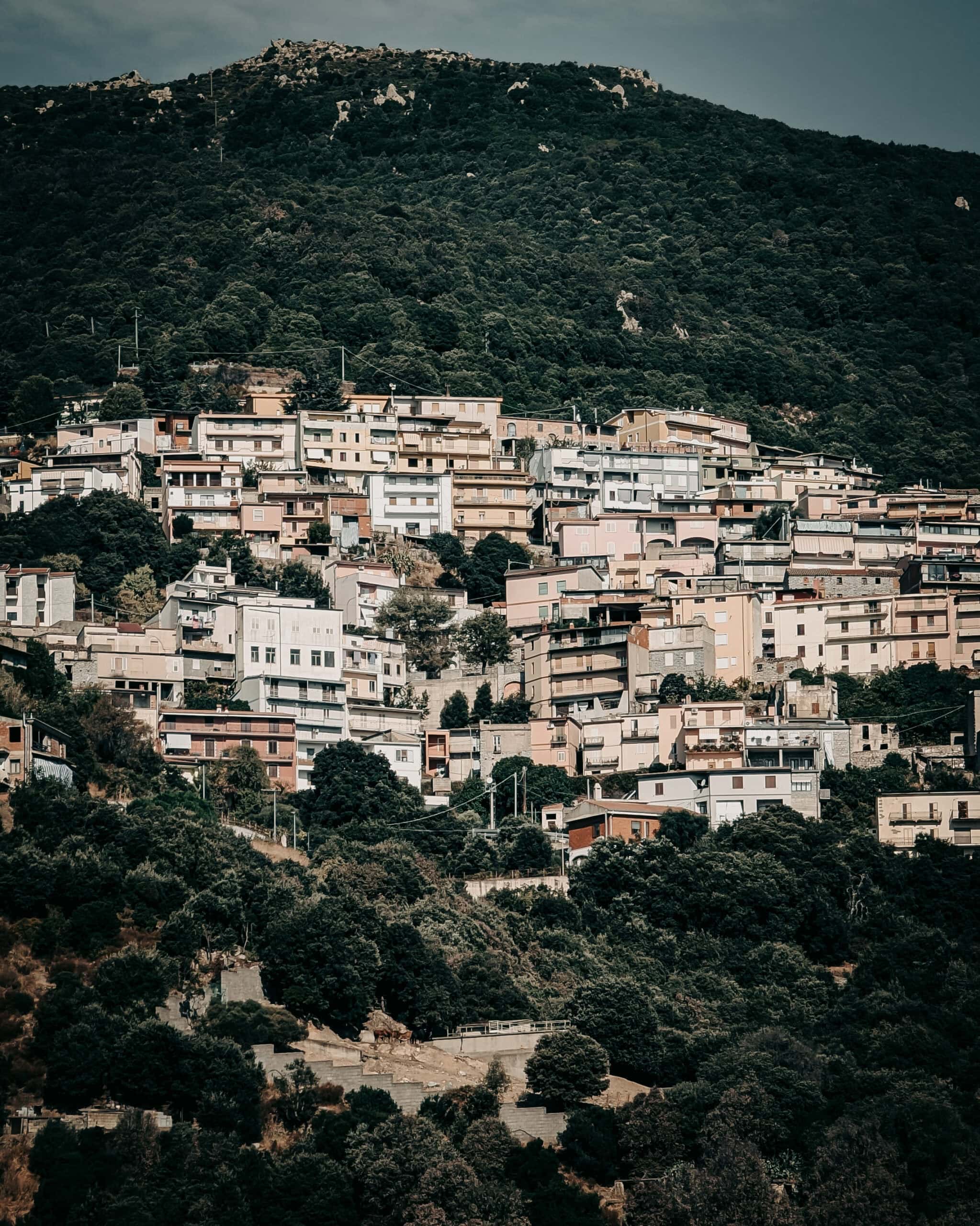
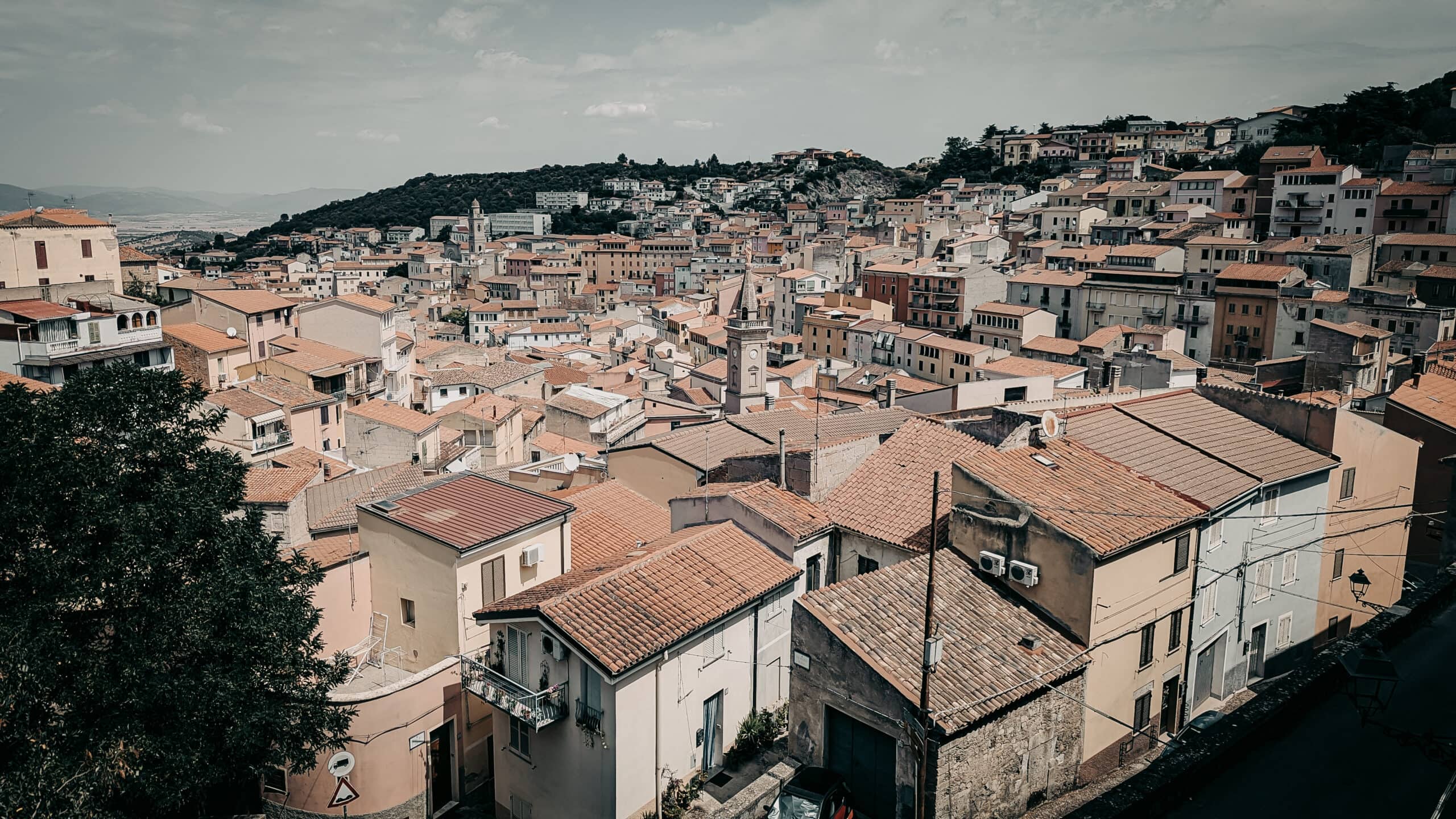
The pass road eventually dropped me back down toward more populated ground, and the villages along the way had that same hillside-stacked look I’d already come to associate with inland Sardinia — terracotta roofs piled up against a green mountainside, church towers poking up above the rooftops, narrow streets that clearly weren’t designed with anything wider than a Fiat Panda in mind. I didn’t stop long in any of them; the goal for the day was still a long way off, and I wanted to keep moving while the light was good, but I slowed down enough each time to take in the view from whatever overlook the road happened to offer as it wound past.
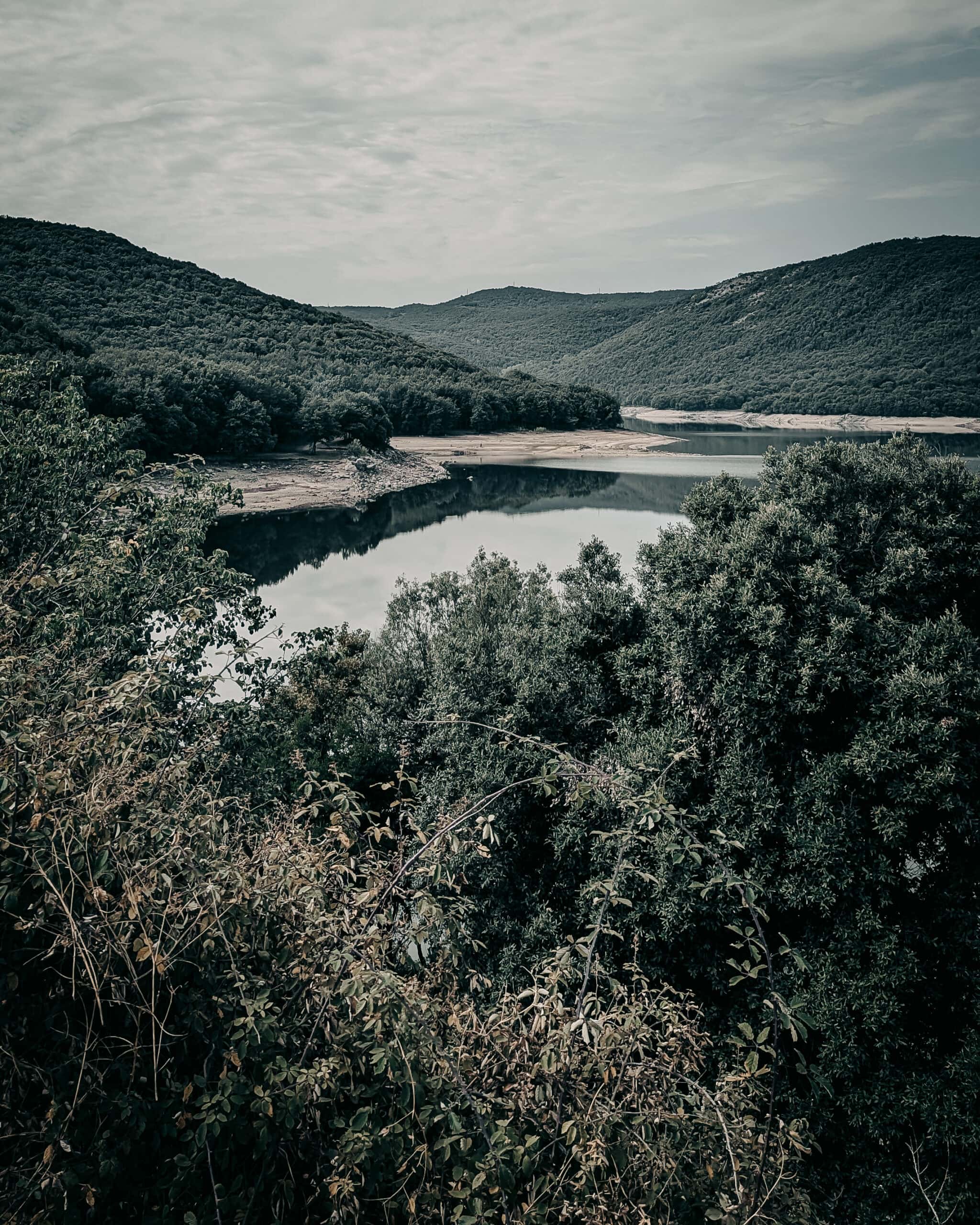
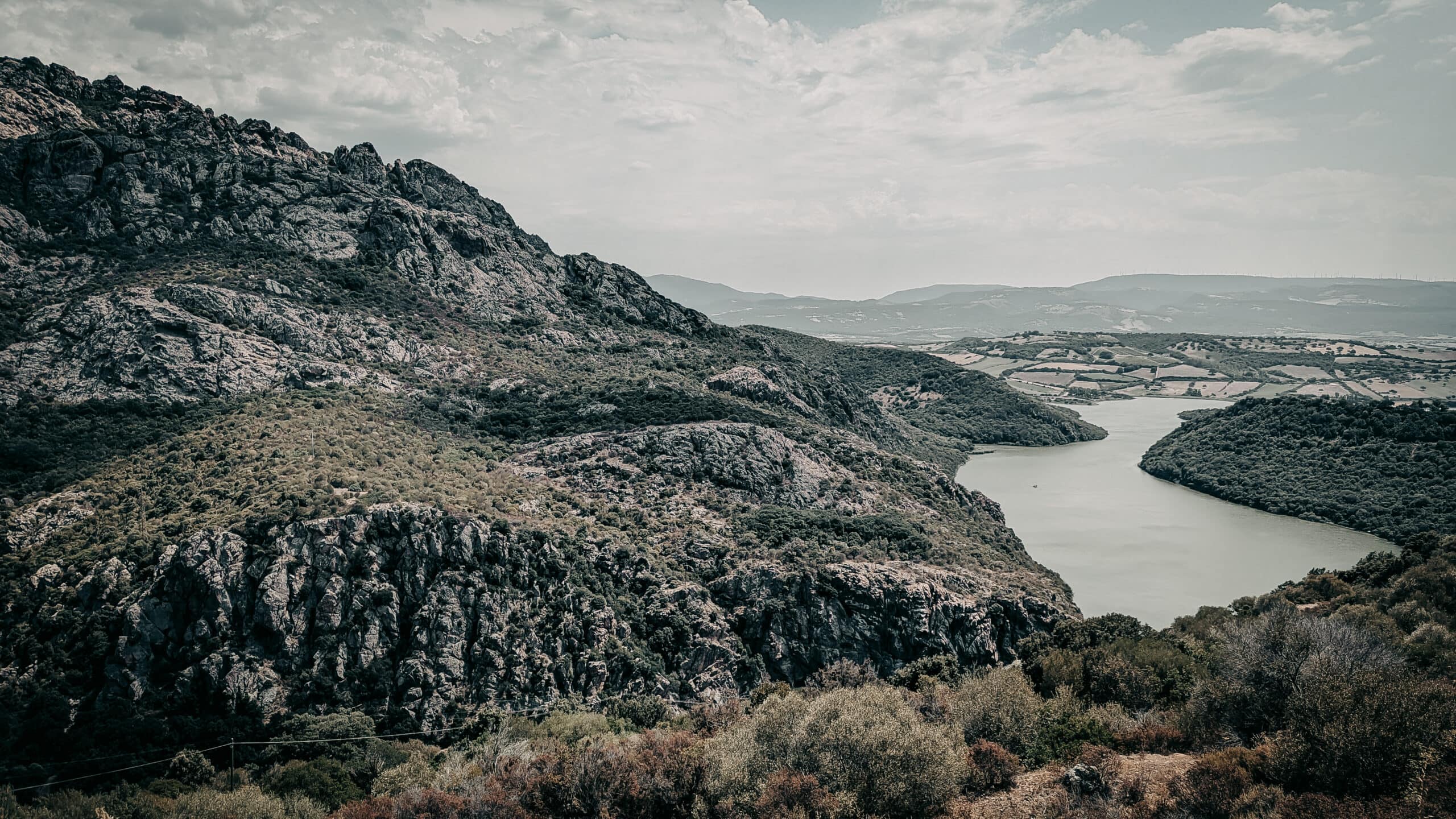
What did make me stop properly was the lake that appeared as I came around a bend later in the afternoon — a long, curving body of water tucked between forested hills, its surface almost perfectly still, mirroring the clouds above it. I later worked out this was near Santa Maria Coghinas, a small town built close to the reservoir that shares its name. The water level looked noticeably low in places, with pale sandy banks exposed where the shoreline had clearly receded over the summer, but the reflection was still beautiful — a rare moment of calm, glassy water after a day spent almost entirely on dry, rocky terrain. I stood there for a few minutes just listening to nothing in particular, which after a full day of engine noise felt like its own kind of luxury. Somewhere beyond the far shore, wind turbines lined a distant ridge, barely visible in the haze, a small reminder that I was finally getting close to more developed, more connected parts of the island again.
From the lake, the roads flattened out and the landscape opened up into the sort of rolling, cultivated countryside you get closer to the northern coast — fewer mountains, more fields, the air noticeably cooler as the afternoon wore on. I kept the pace steady, no longer stopping every few kilometers for photos, mostly because I knew I still had real distance to cover before reaching Santa Teresa Gallura, and the sun was already dropping lower than I would have liked. Traffic picked up gradually too, the first real sign in hours that I was heading back toward somewhere more connected — the occasional camper van, a tractor pulling out of a field, small clusters of houses that grew slightly more frequent with every passing kilometer.
Arriving in Santa Teresa Gallura
By the time I finally rolled into Santa Teresa Gallura, the light was starting to turn golden, and I was more than ready to get off the bike for the day. This is the town at the very northern tip of Sardinia, right at the strait that separates the island from Corsica, and it’s also where the ferry terminal is located — which meant that, unlike most of the smaller places I’d stayed in over the past few weeks, this one felt distinctly geared toward travelers passing through.
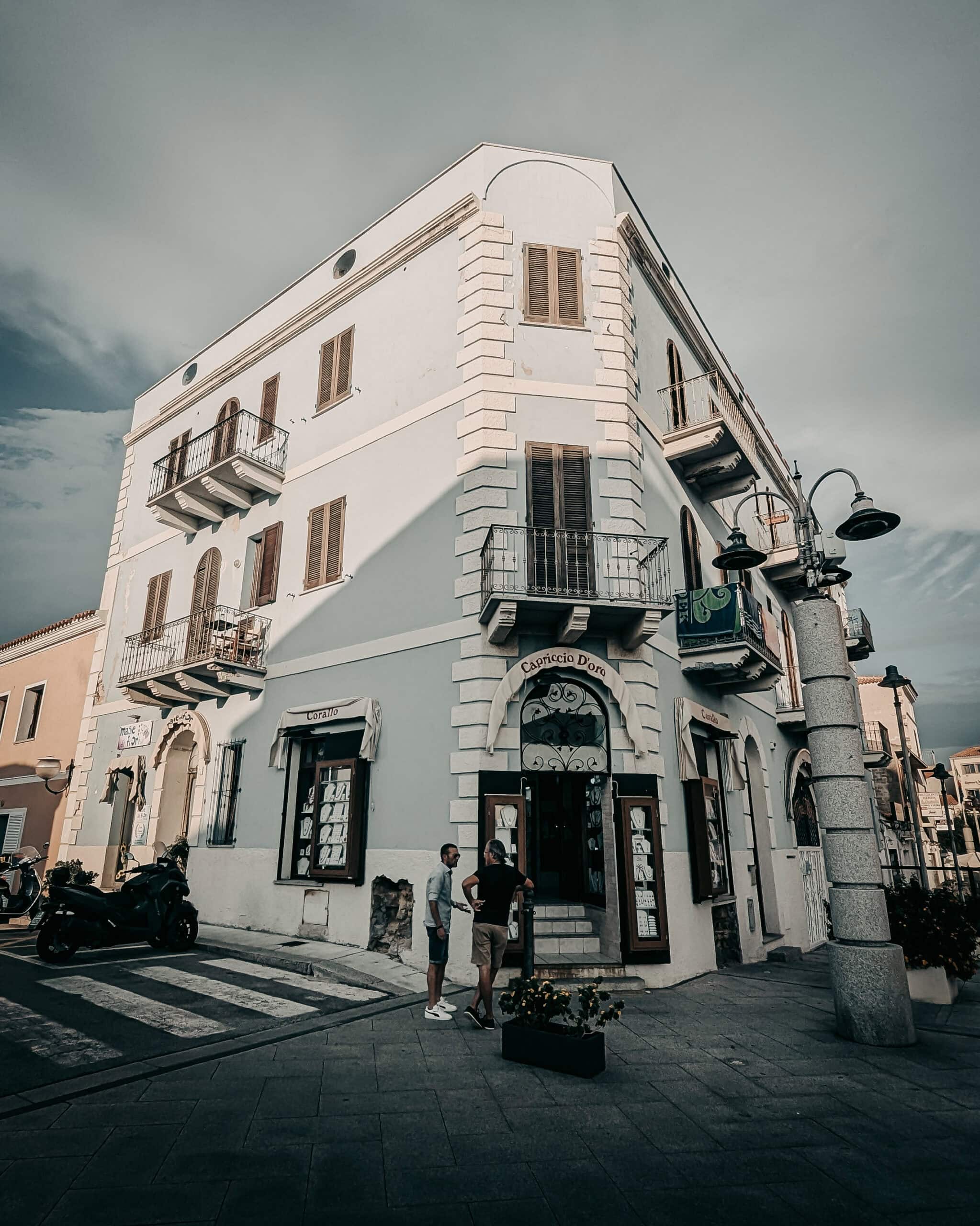
I checked into my accommodation, unpacked what I needed for the night, and left the rest of the luggage strapped to the bike. After a full day riding through empty mountain roads, the contrast when I walked into the town center a little later was almost jarring. Santa Teresa Gallura is clearly a waypoint town, and it shows — the streets were busy with people clearly doing exactly what I was about to do the next morning: killing time before a ferry crossing. Shops selling local coral jewelry lined the corners of elegant old buildings, their window displays lit up as the evening set in. I passed one particularly handsome three-story building on a street corner, its balconies trimmed in wrought iron, a jewelry shop called Capriccio d’Oro tucked into the ground floor with a small crowd of shoppers browsing the window.
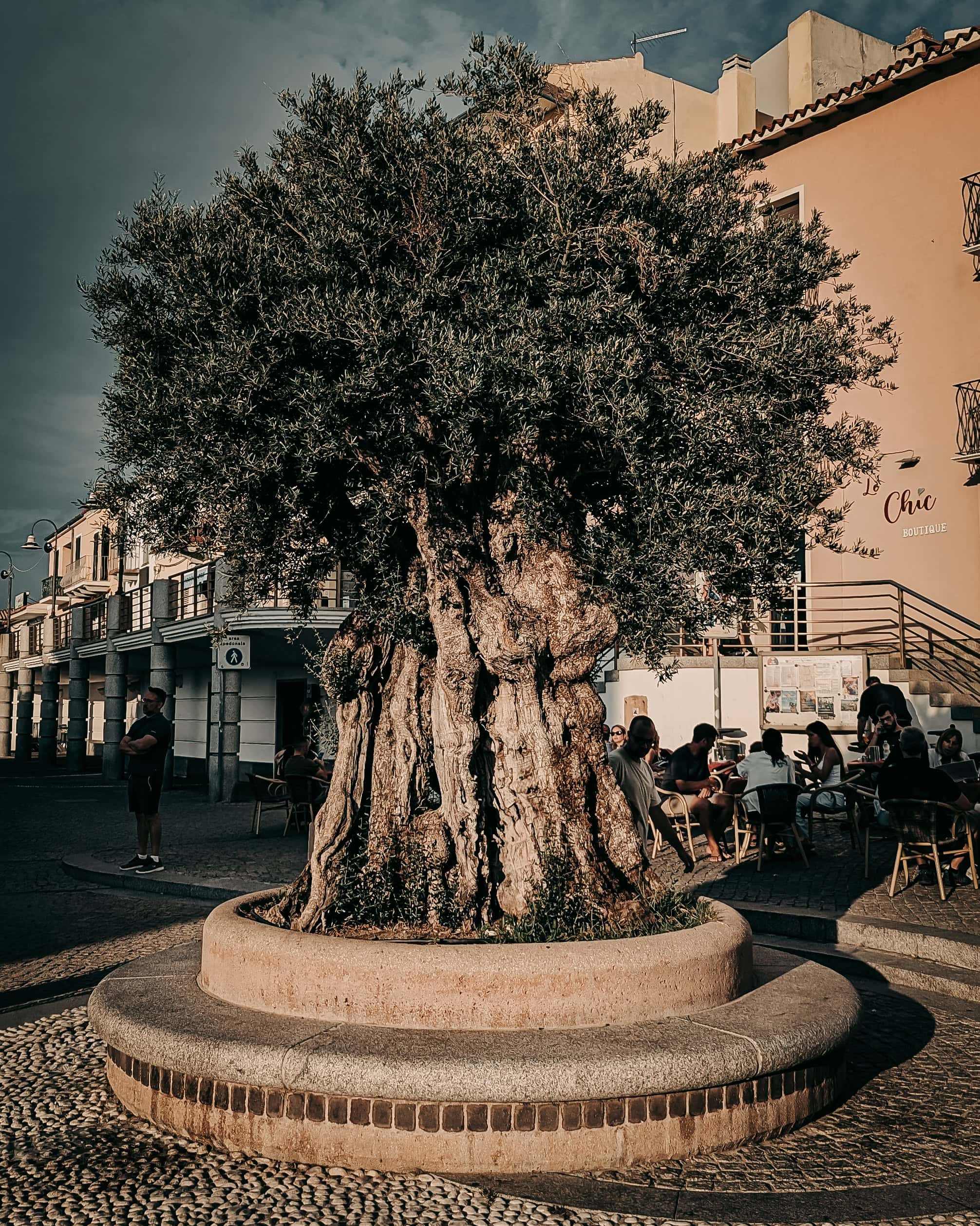
The main square had an enormous, gnarled old olive tree standing at its center, its trunk twisted and split into what looked like a dozen separate limbs, all supporting one dense green canopy overhead. People had pulled up chairs at the cafés surrounding it, and the whole square had a relaxed, end-of-summer buzz to it — clearly a spot where both locals and travelers gather once the heat of the day has passed. A little further down, I found a narrow alley running between two buildings that opened straight onto a view of the sea, framed almost like a photograph: a sliver of blue water, a lone sailboat drifting past, the pink façades of houses stacked along the shoreline below.
One Last Sardinian Dinner
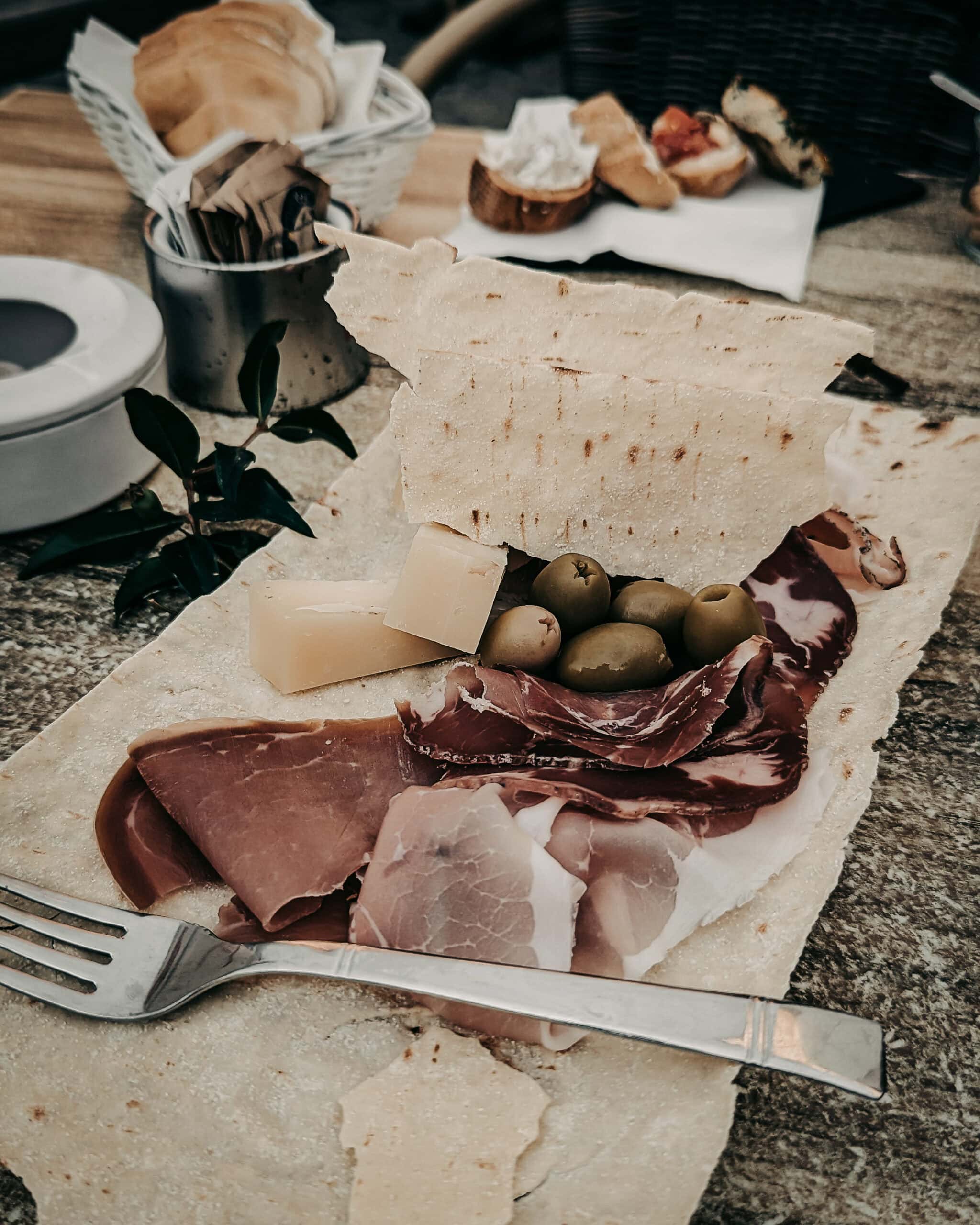
For dinner, I found a small place recommended in one of the local guides and settled in for what I already suspected would be my last proper meal on Sardinian soil for a while. Rather than a full multi-course dinner, I went for what the menu described as a mixed cold platter of local specialties — something like the Sardinian answer to Spanish tapas, a little bit of everything arranged on one board: cured meats, a few different local cheeses, olives, some kind of flatbread that I didn’t recognize but thoroughly enjoyed anyway. It felt like exactly the right way to close out the Sardinian chapter of this trip — not one single iconic dish, but a small sampling of everything the island had to offer, eaten slowly while watching the evening crowd drift through the square.
I didn’t linger too long after dinner, though. Tomorrow meant an early start, loading the bike onto the ferry, and a border crossing of sorts — leaving Italy behind for France, in the form of Corsica. I walked back to the accommodation through streets that were only getting busier as the evening went on, packed my gear as much as I could ahead of time, and got an early night. Twenty-five days in now, one entire island crossed from south to north, and one more water crossing waiting for me in the morning.
Lying there before falling asleep, I found myself running back through the whole Sardinian leg of this trip in my head — Cagliari’s marina, the Seven Brothers park, the coastal detours, and now this last long haul north. Every island has its own personality if you give it enough time, and Sardinia’s had turned out to be a strange, appealing mix of rugged and relaxed: brutal mountain roads one hour, a lazy square with an old olive tree and café chairs the next. I hadn’t expected to feel a little sentimental about leaving a place I’d only known for a handful of days, but that’s exactly what riding somewhere slowly, on two wheels, tends to do to you. You don’t just pass through a place like this — you end up feeling like you’ve properly met it.
Looking back on the day, it struck me how much ground — literal and otherwise — I’d covered since leaving Santa Maria Navarese that morning. A remote mountain pass with donkeys wandering the tarmac, a quiet shrine and a strange, unexplained monument, a still lake reflecting the afternoon sky, and finally a busy little port town buzzing with fellow travelers all waiting for the same crossing I was. Sardinia had given me an enormous range of landscapes over the past week, right up to its very last stretch of road, and I went to sleep that night already looking forward to seeing what Corsica had waiting on the other side of the water.